Reviews And Reputation · 10 min read
Service Recovery in Hospitality: Win the 48 Hour Window
Service recovery in hospitality is a timing problem. How to catch an unhappy guest before checkout, give each complaint an owner and a clock, and fix it fast.
On this page
- 01What is service recovery in hospitality, in operational terms?
- 02Why is 48 hours the window that matters?
- 03How do you hear about problems while the guest is still on property?
- 04How fast should a hotel respond to a complaint?
- 05What should staff say when a guest complains by message?
- 06Who owns the complaint between shifts?
- 07Does recovering during the stay change the review?
Key takeaways
- Service recovery is three clocks: time to detect, time to own, time to close, and the window closes at checkout.
- A problem drops satisfaction 217 points on a 1,000 point scale (J.D. Power 2025), while the average public review reply takes four days (Shiji ReviewPro 2024 data).
- Listening posts inside the stay, a named owner on every complaint and a first reply that says what happens next are the whole system.
The two star review that lands on Monday morning was almost always written by a guest who went quiet on Thursday. You catch an unhappy guest before checkout by putting a listening post inside the stay, reading the tone of every message, and giving each complaint a named owner and a clock. The window closes at checkout. The review follows within days. The whole discipline fits inside our hotel review management software guide, but the operational core is simpler than the software: hear it in time, own it, close it.
I spent years in counseling before I wrote about hotels, and the pattern is identical. People do not escalate right before they give up on you. They go quiet. A guest who stops asking for things has usually decided you cannot help, and the review is where that decision gets written down.
What is service recovery in hospitality, in operational terms?
Service recovery in hospitality is the set of actions a property takes to fix a guest's problem and restore their trust while the guest is still on property. The textbooks dress it in acronyms and talk about a "recovery paradox," where a well handled problem leaves a guest happier than no problem at all. Maybe. I would not build a business on it.
What I would build on is three clocks. Time to detect: how long between the first friction and someone at the property knowing about it. Time to own: how long until a named person picks it up, not a department, a person. Time to close: how long until the guest confirms, in their own words, that it is fixed. A property that can read those three numbers off a screen has a recovery system. A property with an acronym on the breakroom wall has a poster.
The detection clock is the one most resorts never start. A guest with a broken air conditioner on night one who says nothing has a detection time of forever. Everything downstream depends on shrinking that first clock, which is why most of this post is about listening rather than apologizing.
Why is 48 hours the window that matters?
Because the stay is the only period in which you can still change the outcome. For a typical two or three night stay, the gap between first friction and checkout is about 48 hours, give or take a night. Inside that window you can fix the room, move the guest, comp the dinner, send someone up with a sincere apology and a plate of fruit. After checkout, the only tool left is a reply.

In-stay recovery has about 48 hours; after checkout the review follows, and the average public reply takes four days. Source: Shiji ReviewPro benchmark, 2024 data; stay timing is illustrative.
The stakes are measurable. In J.D. Power's 2025 North America Hotel Guest Satisfaction Index, drawn from 39,219 branded hotel guests, 12% experienced a problem during their stay, and when a problem occurred, overall satisfaction fell 217 points on a 1,000 point scale, from 677 to 460 [1]. That is not a dip. That is a different guest.
Meanwhile the industry's public reply, the tool you are left with after checkout, is slow. Shiji ReviewPro's benchmark of 39 million reviews across 11,200 hotels found a global review response rate of 67% and an average response time of four days in 2024 [2]. Four days after a review that was itself posted days after departure. The point of preventing bad reviews before they are written is that the in-stay window is the only fast one you have.
How do you hear about problems while the guest is still on property?
"How is everything?" at the desk does not work, and anyone who has traveled knows why. The honest answer takes effort, the guest is holding a child or a bag, and there is a line. So they say "fine." A listening post has to make the truthful answer easier than the polite one.
Three listening posts, in order of usefulness. First, a mid-stay message on the morning after night one that asks a real question: "Is there anything about your room or your first night we should fix today?" Not a survey. A question with a person behind it. Second, an always-visible written channel, web chat from a QR code in the room, SMS, WhatsApp, so a guest can complain at 9:40pm from the balcony without putting shoes on. Third, staff who are trained to read tone, not just requests. "Can we get more towels" and "we still have not received towels" are different messages, and only one of them is a complaint.
That third post is where sentiment analysis earns its keep. Scoring the tone of a message as it arrives, so a flat "the AC still is not working" is flagged as negative the moment it is sent, turns a quiet guest into a visible one.
If the term sounds like a data science project, it is not. The post on how guest sentiment analysis works without data science covers the mechanics in plain language, and the short version is that a score on a message is just a way of noticing the guest who went quiet.
How fast should a hotel respond to a complaint?
Here are the targets I would set, and I want to be clear that they are recommendations drawn from practice, not research findings. Acknowledge within 15 minutes, on the channel the guest used. Give a real update, or the fix itself, within an hour. Confirm with the guest that the problem is closed before they check out, and get that confirmation in their words, not yours.
Illustrative: a 120 room resort, night two of a stay, 9:40pm. A guest messages on WhatsApp: "The AC in 214 still is not cooling, same as last night." Detect: the message is flagged negative and lands in the escalation queue at 9:40. Own: the night manager claims it at 9:46 and replies, naming the problem, saying maintenance is on the way and promising a confirmation message within 30 minutes. Close: maintenance resets the unit at 10:05, the manager messages at 10:20, and the guest replies "much better, thank you" at 10:31. Three clocks: six minutes, 25 minutes, 51 minutes. Nothing heroic happened. Everyone just knew whose turn it was.
Compare that to the industry's four day average public reply [2]. A property that closes problems inside the hour is not meeting expectations. It is operating in a different category, and guests notice.
What should staff say when a guest complains by message?
The first reply decides whether the guest relaxes or starts drafting the review in their head. The pattern that works has three parts: name the problem in the guest's own words, say exactly what happens next and when, and sign with a name. The counselor in me would add a fourth: do not explain why it happened. Nobody at 9:40pm wants to hear about the compressor.
| Do | Do not |
|---|---|
| "I am sorry the AC in 214 is still not cooling." | "We apologize for any inconvenience." |
| "Maintenance is on the way now. I will message you by 10:15 to confirm." | "We are looking into it." |
| Sign with a first name. | Sign as "The Team" or not at all. |
| Reply on the channel the guest used. | Call the room when they texted. |
| Ask one question if you need one: "Are you in the room now?" | Ask three questions before doing anything. |
| Follow up even if the guest goes quiet. | Treat silence as resolved. |
| Offer something specific after the fix, if warranted. | Lead with compensation before the fix. |
Recommended practice for first replies to guest complaints by text or chat, 2026. These are patterns, not scripts; adapt the words to your property's voice.
"We are looking into it" deserves a special mention because it sounds responsible and lands like nothing. It gives the guest no time, no name and no next step. "Here is what happens next, and here is when" does the opposite, and it is not harder to type.
Who owns the complaint between shifts?
The complaint that gets lost is almost never the one nobody heard about. It is the one the afternoon agent heard, wrote on a sticky note, and the night auditor never saw. A logbook is a record of what happened. It is not a system for making sure something happens next.
A queue is. Every flagged conversation sits in one list, and shift change becomes a review of that list rather than a verbal recap. The general practice is simple: nothing leaves the queue until the guest has confirmed it is closed, and anything unowned for more than a few minutes is everyone's problem. ResortConcierge AI starts the detection clock by scoring sentiment on web chat conversations, so a negative turn is flagged as it arrives rather than discovered in a review.
From there staff escalate the flagged conversation to a person through an escalation queue that shows each guest, the reason and the time it was flagged, which puts the start of the "time to own" clock in front of the whole team. Nobody has to remember the sticky note, because the sticky note is the screen.
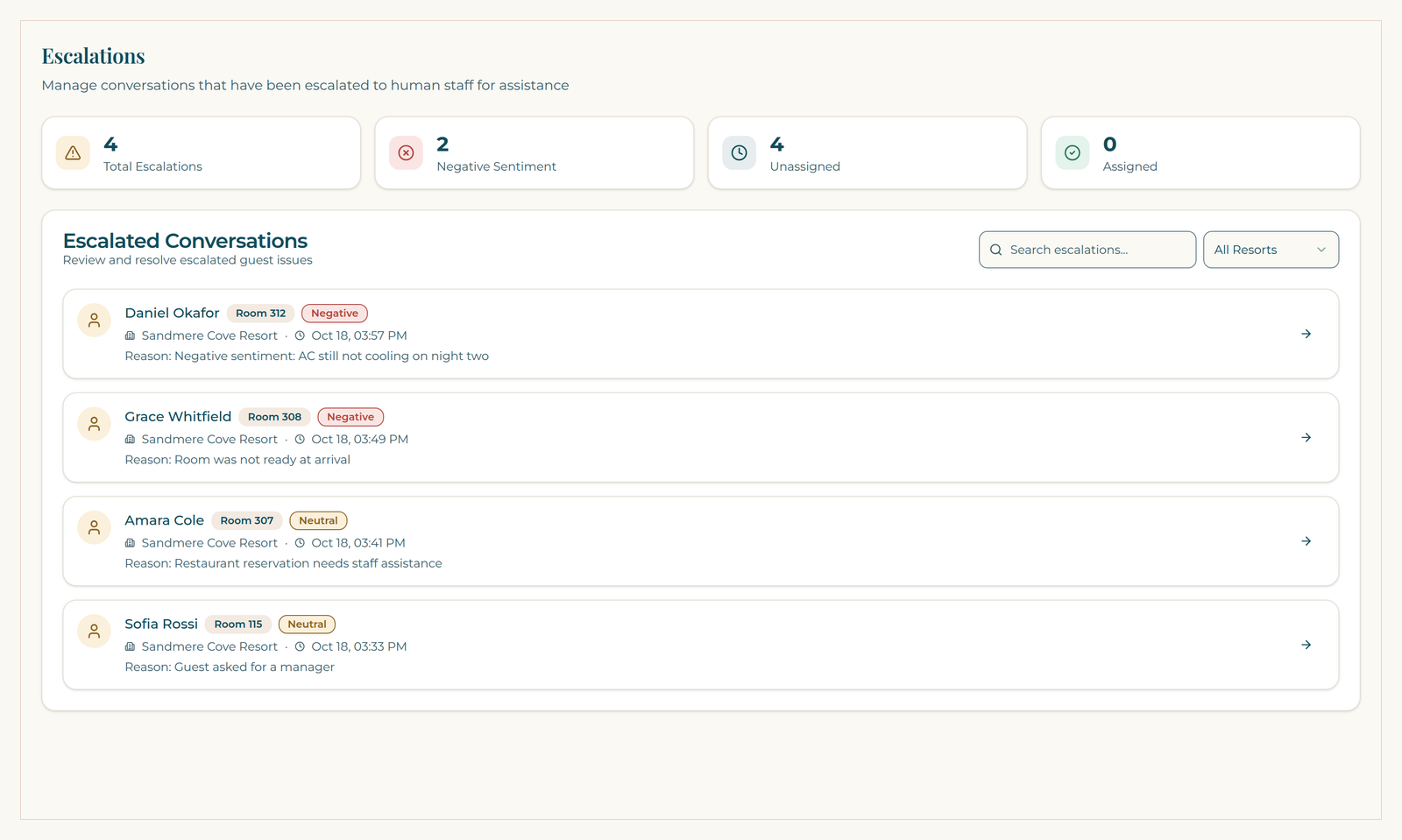
ResortConcierge AI escalation queue, demo property with fictional guests. The AC complaint is flagged negative and waits for a person.
ResortConcierge also offers approval mode (early access), where a person approves every automated reply before it sends. And it can work alongside your property management system (PMS): reservation data is set up during onboarding, and escalations reach your team with the guest, room, reason and sentiment attached.
Does recovering during the stay change the review?
I will not give you a percentage, because there is no reliable one. What the evidence supports is the stakes on both ends. A problem drops satisfaction by 217 points when it happens [1]. And reviews drive bookings: in Tripadvisor's own 2022 research across 9,000 consumers in five countries, 82% said online reviews were extremely or very important when choosing accommodations [4], and Tripadvisor commissioned that study, so weigh it accordingly. The recovery chapter of Reviews Are Revenue, ResortConcierge AI Research's synthesis of the published evidence, lands in the same place: no hotel study yet links a fix before checkout to the posted review.
The revenue link is older but foundational. Chris Anderson's 2012 Cornell study found that a one point increase on a five point review scale allowed a hotel to raise price about 11% and keep the same share of bookings [3]. That finding deserves its own post, and what a one point review gain is worth goes through it in depth. For here, the point is that every problem caught on Thursday is a review you did not have to answer on Monday, and a score you did not have to earn back.
So measure it yourself. For one quarter, count complaints heard on property and complaints first seen in a review. Track the three clocks on every flagged conversation. Then read your reviews and mark which ones mention a problem the team already knew about. That ratio is your recovery system's report card, and no benchmark can give it to you. When the review does come, answer it fast and personally; how to respond to a negative hotel review covers the second window.
Start this week with the mid-stay message. One sentence, sent the morning after night one, with a real person's name on it. Then watch what comes back, because the guests who were about to go quiet will tell you exactly where the 48 hours are being lost.
Frequently asked questions
Private founding offer
Five resorts. One founding rate.
We are opening the concierge to five founding resorts. You get a locked founding rate, a 90-day readout on guest requests and staff time, and you start without a card.
- Open to five resorts only
- Founding rate locked in
- 90-day readout
- No card to start
Sources and notes (4)
- 1.2025 North America Hotel Guest Satisfaction Index (NAGSI) Study (opens in a new tab) J.D. Power, via Business Wire, 2025
- 2.What Guest Reviews Tell Us About Hospitality in 2024 (Shiji ReviewPro Guest Experience Benchmark Report) (opens in a new tab) Hospitality Net, 2025
- 3.The Impact of Social Media on Lodging Performance (opens in a new tab) Cornell Center for Hospitality Research (Chris K. Anderson), 2012
- 4.The Power of Reviews (opens in a new tab) Tripadvisor, reported by Hospitality Net, 2022

Written by
Brittany RoachWriter, guest experience
Brittany Roach writes about guest experience from both sides of the front desk: a career spent helping people through complicated moments, and a lot of time as a traveler with a family in tow.
Keep reading
Related articles
Improve Hotel Review Score First: Why It Beats a Rate Increase
Improve hotel review score before you touch the rate card: the evidence by year, a worked example for a 150 room resort, and a 90 day plan to earn the points.
Guest Sentiment Analysis for Hotels, No Data Science Required
Guest sentiment analysis reads guest text and estimates tone, strength and topic. What a score means, where it goes wrong, and what a hotel team does with it.

How to Get Your Hotel Recommended by ChatGPT: Do Reviews Decide?
How to get your hotel recommended by ChatGPT: what the evidence says about reviews, why volume beats chasing a perfect score, and how to ask within the rules.