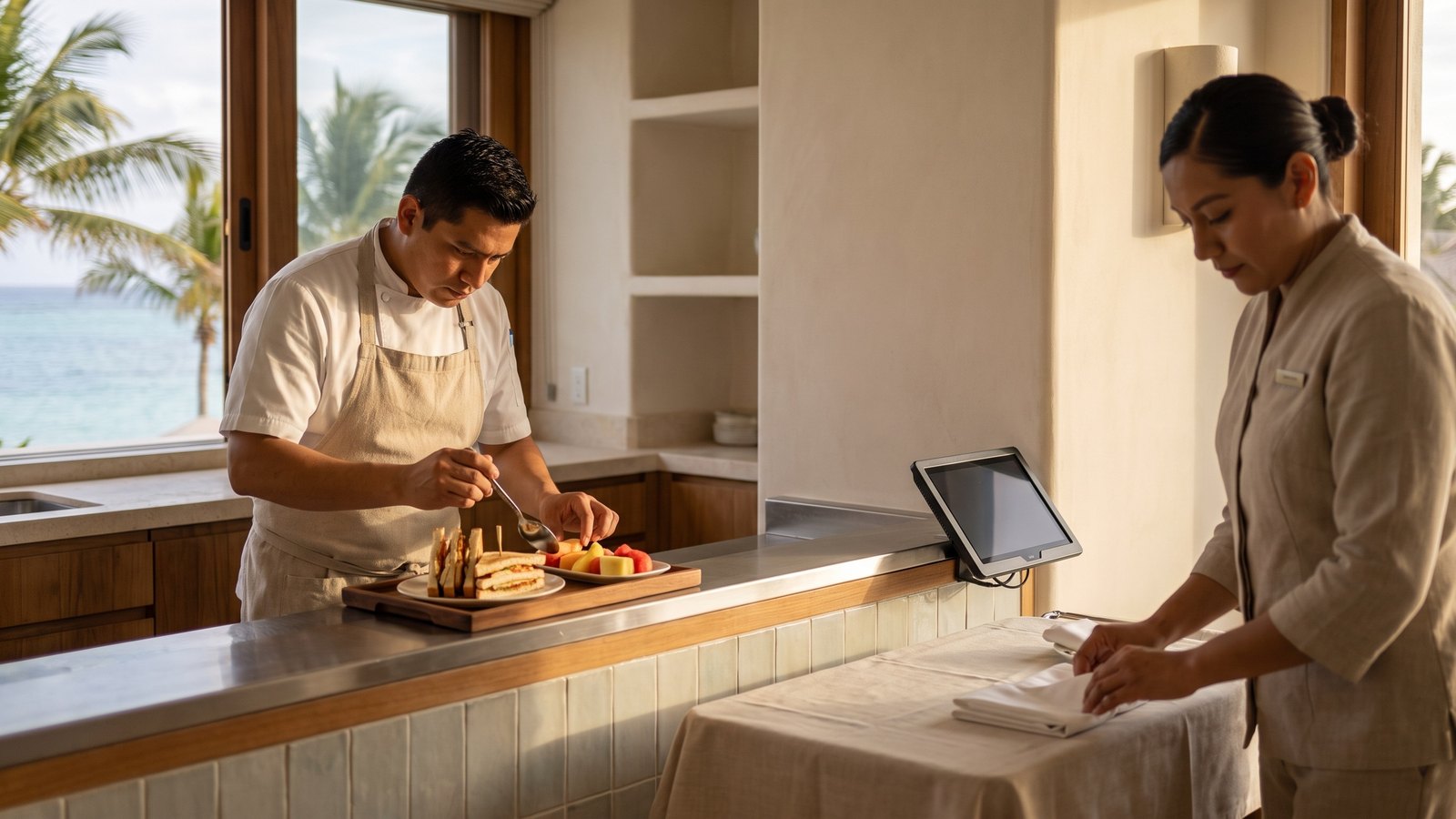
Do Hotel Guests Want AI? Where They Still Want a Person
Do hotel guests want AI? Yes for routine questions, but they want a person for the welcome and for problems. See what 2026 surveys show at each touchpoint.
A vendor-neutral buyer's guide to evaluating AI concierge platforms, the criteria that separate real systems from scripted chatbots.
The best hotel AI concierge platform is the one that is trained on your property's specific knowledge, resolves guest needs end to end rather than just answering FAQs, supports your guests' languages, and connects to your operations. This guide explains the criteria to weigh and the questions to ask before you commit to any vendor.
It answers from your menus, policies, and FAQs, not generic web data.
It can log service requests and bookings, not only chat.
It hands off to staff with full context at the right moment.
It serves international guests in their own language, including RTL.
It detects frustrated guests and flags them in real time.
Can work alongside your PMS, with reservation data set up during onboarding.
Routine questions shift to the AI, freeing staff for high-touch service.
Guests get instant answers at any hour, without added headcount.
Faster resolutions and fewer dropped requests lift CSAT and reviews.
In-conversation recommendations drive spa, dining, and activity spend.
Every guest is served in their own language, including right-to-left Hebrew.
Review ResortConcierge AI's property-aware text concierge, service requests, staff escalation, sentiment tools, multilingual support with RTL Hebrew, usage-based pricing, and multi-property management against your requirements.
From the operator journal
Do hotel guests want AI? Yes for routine questions, but they want a person for the welcome and for problems. See what 2026 surveys show at each touchpoint.
Hotel employee turnover cost is mostly the learning curve. See one front desk resignation priced line by line, with a worked example to redo.
Hotel flow through is how much of each new revenue dollar reaches profit. Here is why resort revenue grew while profit did not, and which offers keep the most.
The best AI for hotels depends on your property and the problem you are fixing: six categories, two decision matrices, a demo scorecard and vendor questions.
What an AI concierge for hotels is, how it differs from the chatbot you tried in 2019, how it knows your property, what goes wrong and which one a resort needs.
AI concierge cost in 2026 from published list prices: per room, flat, usage and module pricing, fees outside the license, and a year-one budgeting worksheet.
AI disclosure for hotel guests, by jurisdiction: what the EU AI Act, California and Utah require, what guests prefer, and wording that satisfies all three.
How AI room service works in a hotel: a guest orders from a structured menu in chat, the kitchen gets a ticket, and a person handles every allergy question.
An escalation queue hotel teams can trust: what triggers a handoff from AI to a person, who owns the list, how fast to pick up, and what happens if nobody does.
How to route service requests through chat: type each guest message, give it a priority and an owner, acknowledge the guest at once, and track it to done.
After hours hotel coverage in three streams: questions that need no person, requests that can wait until a stated time, and problems with a named on-call owner.
A hotel shift handover system that keeps guest requests alive: one owner at every minute, explicit transfer, a shared open requests list and a short stand-up.
How to train AI on hotel information: a six tier loading order from the 30 daily desk questions to the refusal list, and the routine that keeps it true.
Supervised AI in a hotel is a rollout method: a person approves every reply, then hands over categories as corrections stop. Four rungs and the exit rules.
AI guardrails hospitality teams can run: six categories an AI concierge should decline, how a refusal should sound, and a 30 question test before launch.
Hospitality AI ROI measured with five numbers an owner already trusts: hours freed, response time, problems recovered, incremental revenue and review response.
A hotel technology pilot program that ends in a decision: five baseline numbers written before launch, a weekly review, and a one page owner readout at day 90.
What routine guest questions cost a 150 room resort each month, and how to reduce front desk calls by moving that volume to channels guests already use.
Seasonal hotel staff training in five days: put the property's answers in one knowledge base, run read, systems, shadow, buddy, solo, and log what is missing.
Hotel staffing shortage solutions start with the people you can actually hire. Build the 2027 plan from tasks, automate routine questions, hire for judgment.
Ancillary revenue per occupied room shows what each guest spends beyond the room rate: the definition, the benchmarks that exist, and the levers that move it.
A late checkout upsell works when it is priced by the hour, offered the evening before, capped by arrivals and housekeeping, and confirmed before the knock.
Hotel upselling strategies built on timing, not scripts. Which offers guests actually buy, when they say yes, and the moments that make them resent the pitch.
Spa booking conversion at a resort rises when the guest's question becomes the booking: one catalog, a named confirmer, an expiring hold, no software rebuild.
A hotel guest data privacy and AI policy fits on one page: seven plain English sections, the GDPR rule behind each, example lines and a vendor checklist.
Book a walkthrough mapped to your property, or start a free trial today.