Revenue · 10 min read
Hotel Upselling Strategies: The Moments Guests Say Yes To
Hotel upselling strategies built on timing, not scripts. Which offers guests actually buy, when they say yes, and the moments that make them resent the pitch.
On this page
- 01Which hotel upsells do guests actually buy?
- 02When during the stay are guests willing to say yes?
- 03Which moments make guests resent the offer?
- 04How do you upsell without being pushy?
- 05How should the offer be delivered: email, text, chat or the desk?
- 06How do you keep an upsell from becoming a service failure?
- 07How do you measure which moments work?
Key takeaways
- Early check-in and late checkout were 90% of upsell revenue on Akia's platform in the 12 months to July 2026; suites rarely sell.
- Guests say yes in the morning and when they planned ahead; the check-in line and any open complaint are the moments to stay silent.
- One offer per moment, a plain price, a one tap no, and a housekeeping check before late checkout goes out.
The upsells guests say yes to are the ones that solve a need they already have at that moment, offered on a channel they can decline in one tap. The data is blunt about what that means in practice: mostly early check-in and late checkout, bought in the morning, by guests who booked well ahead. Everything else in hotel upselling strategy is timing. If you are evaluating tools that can deliver offers in conversation, start with our guide to AI concierge platforms for resorts; this post is about the moments, not the software.
I have been pitched a suite upgrade at a check-in desk with two children past their limit and a stroller wedged against the counter. The agent was doing exactly what she had been trained to do. I said no with more edge than she deserved, and I remember the offer far longer than I remembered the room. That is the whole problem with upselling by script. The right offer at the wrong moment is a complaint with a price tag.
Which hotel upsells do guests actually buy?
Not suites. Across roughly two dozen hotel and vacation rental operators on Akia's messaging platform, in the 12 months ending July 2026, early check-in and late checkout accounted for 90% of upsell revenue and 96% of sales, and the average sale was about $78 [1]. That is vendor platform data that includes vacation rentals, not an independent study, so treat it as a strong signal rather than a benchmark. The signal is hard to miss. ResortConcierge AI Research's In-Stay Revenue Report on what guests buy reads this Akia dataset beside the rest of the published evidence, including the prices guests actually paid and the offers, such as spa and dining, that never appear in it.
Mews' Data Snap, drawn from thousands of properties in more than 85 countries, found the top upsells by revenue in summer 2024 were breakfast, extra nights, parking, late check-out and early check-in [2]. Different platform, different guest mix, same shape: flexibility around arrival and departure, plus the things a guest needs anyway.
What sells and when
| Offer | Best moment | Channel | Source |
|---|---|---|---|
| Early check-in | Week before, confirmed the day before | Email, then message | Akia 2026 [1], Mews 2024 [2] |
| Late checkout | Night before departure, or checkout morning | Message | Akia 2026 [1], Mews 2024 [2] |
| Breakfast | Booking confirmation | Mews 2024 [2], Revinate 2026 [3] | |
| Parking | Booking confirmation | Mews 2024 [2] | |
| Extra night | Night before departure | Message, or desk if the guest raises it | Mews 2024 [2] |
| Room upgrade | Week before, only when the guest asks about space or view | Email or chat | Recommended practice; rare in Akia 2026 data [1] |
| Activities and spa | Week before (activities); mid-stay morning (spa) | Email; chat | Revinate 2026 (activities 16% of upsell activity) [3]; practice |
| Food and beverage | Mid-stay morning, or in conversation | Chat | Revinate 2026 (34% of upsell activity) [3] |
Sources: Akia platform data, 12 months to July 2026, includes vacation rentals [1]; Mews Data Snap, summer 2024 [2]; Revinate 2026 email benchmark, Revinate customer data [3]. "Best moment" and "channel" are recommended practice unless a source is named.
When during the stay are guests willing to say yes?
In the morning, and most often from guests who booked well ahead. Akia's data found 58% of upsell purchases happened between 7am and 1pm local time, and guests who booked 31 to 60 days ahead attached a paid upsell at 3.66% versus 0.89% for same-day arrivals [1]. Overall, only 1.59% of stays included a paid upsell at all [1], which tells you how much headroom there is and how little of it a hard sell will capture.
Pre-arrival email is read more than most GMs think. Revinate's 2026 benchmark, drawn from its customers' email programs, found confirmation emails open at 67% and pre-arrival emails at 58%, with pre-arrival campaigns converting at 2.5% and upsell revenue per booking of $86 on confirmation and $82 on pre-arrival [3]. Only 36% of hotels globally run email upsells at all [3]. The confirmation email is the best read message you will ever send, and most properties use it for the cancellation policy.

Recommended offer windows across a stay. Purchase timing: Akia platform data, 12 months to July 2026.
So the map looks like this. Confirmation: breakfast, parking. Week before: early check-in, activities. Day before: arrival time, transfers. Arrival: nothing. Mid-stay morning: spa, dining. Night before departure: late checkout, extra night. Checkout morning: nothing new, just honor what was bought.
Which moments make guests resent the offer?
I do not have a survey on resentment, and I would not trust one that claimed to measure it. What I have is a lot of nights as the guest and a counselor's habit of noticing when someone's shoulders go up. Four moments do it reliably.
The check-in line, because the guest is tired, the kids are done and anything that is not a key feels like an obstacle. Mid-complaint, because offering a spa discount to someone whose shower is cold tells them you were not listening. Repetition, because the third prompt for the same late checkout reads as pressure, not service. And anything that implies the room they booked is being withheld: "would you like to upgrade to a room with a working view" is a joke, but the feeling behind it is common.
Underneath all four is the same thing. The guest is in a moment that is about them, and the offer makes it about you. The fix is not a softer script. It is to stop offering in those moments entirely and move the offer to one where the guest is already thinking about the thing you are selling.
How do you upsell without being pushy?
Four rules, and they are mostly subtraction. One offer per moment, never a menu. A plain price with a plain time: "Late checkout until 2pm is $40, would you like it?" A one tap no that ends the conversation without a follow-up. And relevance to the guest's own question: if they ask what time checkout is, that is the moment; if they ask where the pharmacy is, it is not.
| Do | Do not |
|---|---|
| Offer late checkout the evening before to guests who are leaving | Offer it to every guest every day |
| Answer the question first, then offer | Lead with the offer |
| State one price and one time | Present three tiers in a text message |
| Let "no" end it | Follow up on a decline |
| Hold offers during any open complaint | Pitch the spa to a guest waiting on maintenance |
| Say what the guest gets, in their terms | Say what the hotel calls it ("enhancement") |
Recommended practice, 2026. Not drawn from a survey.
The counselor's version of this is simple: people say yes when they feel seen, and no when they feel managed. An offer that answers a question the guest just asked feels like being seen. An offer that interrupts feels like being managed, however gently it is worded.
How should the offer be delivered: email, text, chat or the desk?
Match the channel to the moment. Email carries the long-lead offers, breakfast and parking at confirmation, early check-in and activities the week before, because the guest is planning and will read a paragraph. Messaging carries the day-before and in-stay offers, because the guest is on their phone and wants one line. The desk carries only the offers the guest raises first.
Guests have been ready for this for years. In Oracle Hospitality and Skift's 2022 survey of 5,266 consumers, 39% said they would order room service through a phone app or chatbot [4], and that was before most of us had a WhatsApp thread with a dentist. The general practice is one offer to one segment at one moment: late checkout to tomorrow's departures on a day with few arrivals, not a blast to the house. ResortConcierge AI sends offers through guest journeys timed from each guest's stay dates, which is how offers triggered by the moment in the stay replace the blanket message.
The other delivery moment is inside a conversation the guest started. When a guest asks in chat what time checkout is, the right answer is the checkout time and, in the same breath, whether they would like to extend it. ResortConcierge answers the question and presents the relevant offer in that same exchange, which is the practical meaning of increasing upsell revenue in conversation: the guest asked, so the offer is help.
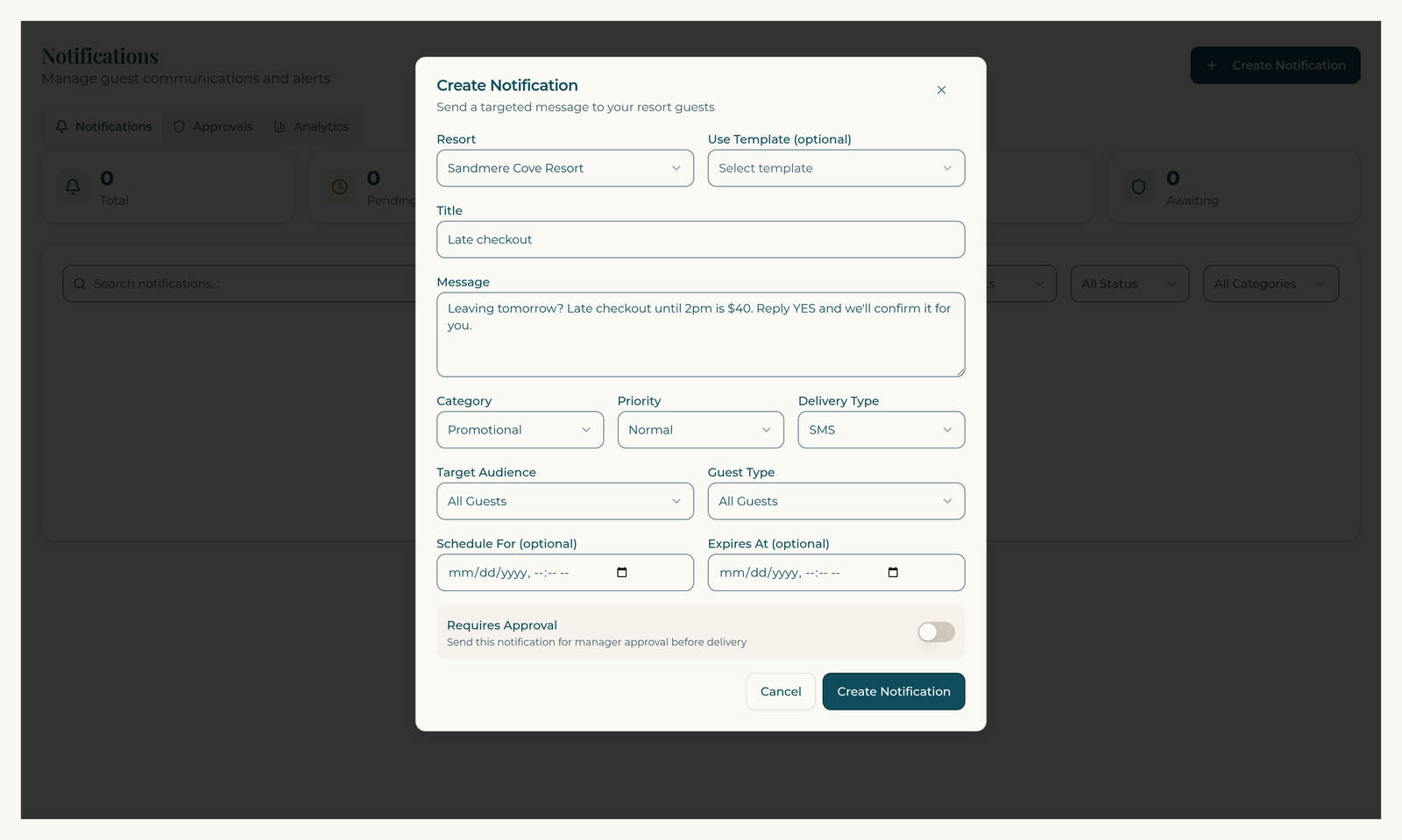
ResortConcierge AI notification composer on a demo property, with a late checkout offer drafted.
How do you keep an upsell from becoming a service failure?
The fastest way to turn $40 of revenue into a one star review is to sell a late checkout that housekeeping did not know about. The offer and the operation have to be one record. Before late checkout goes out to tomorrow's departures, someone checks tomorrow's arrivals. Before a spa slot is offered in chat, someone knows the spa has the slot.
Illustrative: a 150 room resort has 60 departures tomorrow and 20 arrivals. Housekeeping can comfortably hold 15 rooms until 2pm. The evening before, a late checkout offer at $40 goes to the 60 departing guests. If 10% accept, that is six rooms and $240; if 15% accept, nine rooms and $360. Both are inside the 15 room limit, so nobody is cleaning around a guest. Those acceptance rates are assumptions, not results. The point of the arithmetic is the capacity check, not the revenue. You can estimate the revenue lift with the ROI calculator using your own departures and price.
Each accepted offer should create a task someone can see: housekeeping for late checkout, the activities desk for a booking, the kitchen for a dining reservation. That handshake deserves a post of its own, which is why late checkout as a product exists. ResortConcierge can work alongside your property management system (PMS), with reservation data set up during onboarding, and staff check availability and post the charge to the folio there, as they do today.
How do you measure which moments work?
Three numbers, by moment, for 90 days. Attach rate: offers accepted divided by offers sent, for each moment and channel. Revenue per occupied room from upsells, so a busy week and a quiet week can be compared. And complaints by moment, including the quiet ones, like a guest who declines and then goes short with the desk.
Then prune. A moment with a low attach rate and zero complaints is a candidate for a better offer. A moment with any complaints is a candidate for deletion, regardless of revenue. If you want a sense of where your overall number sits, the ancillary revenue per occupied room benchmarks post gathers what public data exists, which is less than you would hope.
Pick one moment this week, the night before departure, and one offer, late checkout at one price. Send it to tomorrow's departures after you have checked tomorrow's arrivals. Watch who says yes, and notice how few people mind being asked when the question arrives at the moment they were already wondering.
Frequently asked questions
Private founding offer
Five resorts. One founding rate.
We are opening the concierge to five founding resorts. You get a locked founding rate, a 90-day readout on guest requests and staff time, and you start without a card.
- Open to five resorts only
- Founding rate locked in
- 90-day readout
- No card to start
Sources and notes (4)
- 1.Which Hotel Upsells Sell Best (opens in a new tab) Akia (platform data, 12 months ending July 2026), 2026
- 2.Hotel Performance Insights: Benchmarking and Trends from the Mews Data Snap 2024 (opens in a new tab) Mews, via Hospitality Net, 2024
- 3.2026 Hospitality Benchmark Report, email channel (global) (opens in a new tab) Revinate, 2026
- 4.Oracle Research: 73% of Travelers More Likely to Choose Hotels Offering Self-Service Tech (opens in a new tab) Oracle Hospitality and Skift, via Hospitality Net, 2022

Written by
Brittany RoachWriter, guest experience
Brittany Roach writes about guest experience from both sides of the front desk: a career spent helping people through complicated moments, and a lot of time as a traveler with a family in tow.
Keep reading
Related articles
Ancillary Revenue per Occupied Room: Benchmarks and Levers
Ancillary revenue per occupied room shows what each guest spends beyond the room rate: the definition, the benchmarks that exist, and the levers that move it.
Late Checkout Upsell: Pricing, Timing and Housekeeping
A late checkout upsell works when it is priced by the hour, offered the evening before, capped by arrivals and housekeeping, and confirmed before the knock.
Hotel Flow Through: Why More Resort Revenue Is Not More Profit
Hotel flow through is how much of each new revenue dollar reaches profit. Here is why resort revenue grew while profit did not, and which offers keep the most.