Staffing And Labor · 11 min read
After Hours Hotel Coverage Without a Night Auditor Doing Two Jobs
After hours hotel coverage in three streams: questions that need no person, requests that can wait until a stated time, and problems with a named on-call owner.
On this page
- 01What does the night auditor actually do, and what keeps interrupting it?
- 02What actually comes in after 10pm?
- 03What can wait until morning, and what cannot?
- 04How do you say "this will be handled at 7am" without sounding like you do not care?
- 05How do you escalate overnight when the escalation target is asleep?
- 06Can AI answer guest questions at night, and what should it never handle alone?
- 07How do you protect the audit itself?
Key takeaways
- Overnight coverage is three streams: information answered automatically on messaging, can-wait requests logged with a stated time, and a short cannot-wait list with a named owner and on-call path.
- The second overnight hire is not coming; 71% of hotels had unfilled openings in AHLA's 2025 survey, so the design constraint is one person and what they get interrupted for.
- AI covers written channels at night, not the phone, until voice ships; safety, medical, money and upset guests always go to a person.
- Protect the audit with a do-not-interrupt window and one legitimate interrupt source, the escalation queue.
You cover the front desk after 10pm by splitting what arrives into three streams: questions that need no person, requests that can wait until a stated time, and problems that cannot wait and have a named owner. Messaging handles the first stream automatically. Triage rules and an on-call rota handle the other two. The night auditor watches one list instead of every channel, and the audit gets done. That is the model, and the tools that support it are covered in our guide to the best hotel AI concierge platforms; this post is about the operating rules underneath them.
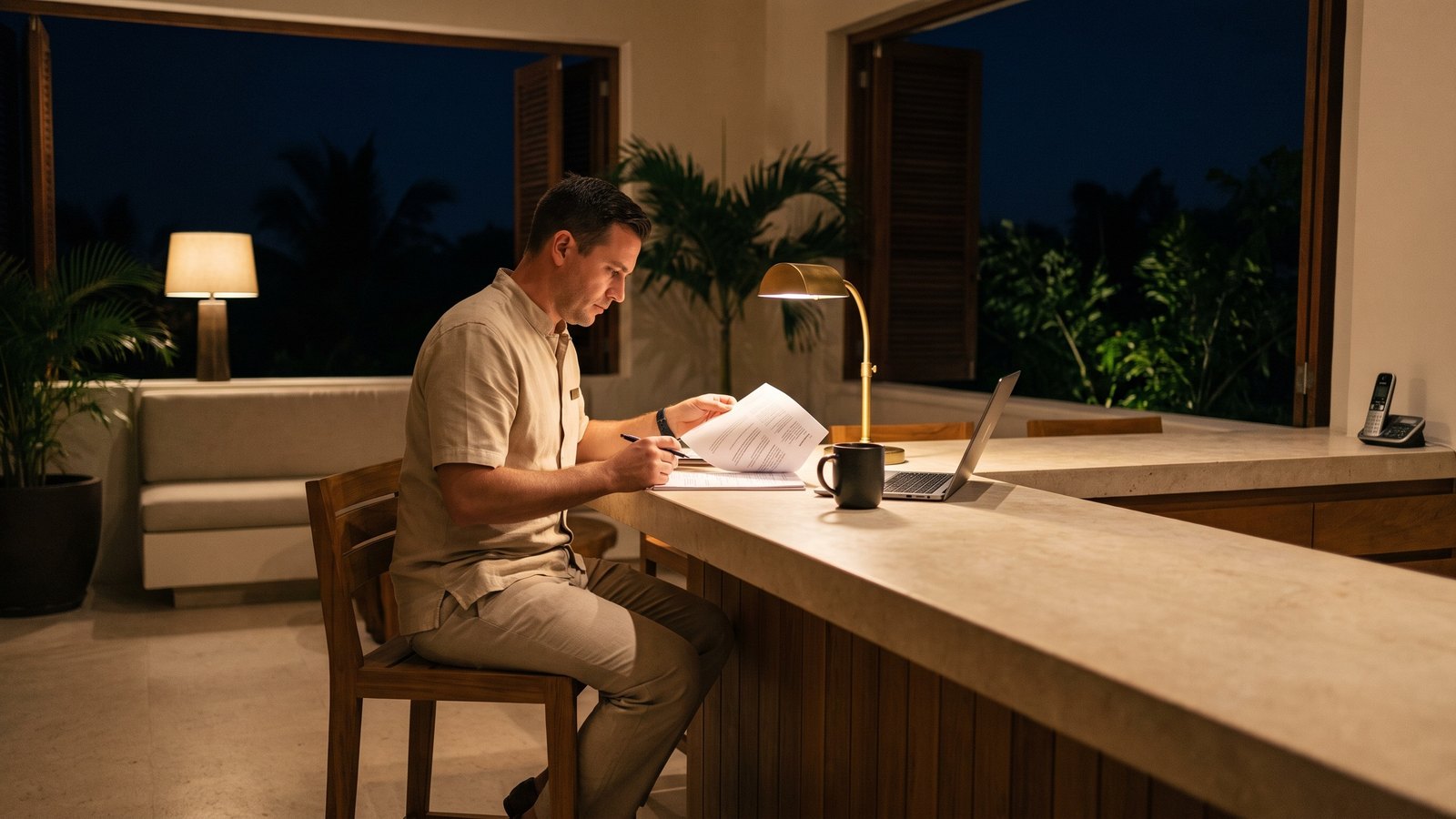
The real cost of the overnight shift is not the interruptions. It is that the person being interrupted has a second job with a deadline. Every "what time is breakfast" at 1am is a context switch away from a reconciliation that has to balance before 7.
What does the night auditor actually do, and what keeps interrupting it?
The night auditor closes the day. Charges and payments reconciled, room and tax posted, departments balanced, reports run for the morning team and the owner, and the property management system (PMS) rolled to the next date. It is careful, sequential work, and it is sensitive to interruption in the way that counting anything is: lose your place and you start the column again.
At most independents the auditor is also the only guest-facing person in the building from 11pm to 7am. The interruptions are mostly not emergencies. They are the phone ringing with questions the website answers, a walk-in, a guest at the desk asking for a toothbrush. Each is small. Together they are why the audit is finished at 6:40 with the morning team already arriving.
The second overnight body is not coming. In the AHLA and Hireology 2025 survey of 282 hoteliers, 65% reported staffing shortages, the front desk was a most critical opening at 26% of hotels, and 71% had unfilled openings, averaging six to seven per property [1]. The hotel staffing shortage is the setting for every decision in this post: the design constraint is one person, so the question is what that one person should be interrupted for.
If you want the owner to see the overnight cost in hours rather than complaints, estimate the hours involved in the information stream alone before you change anything.
What actually comes in after 10pm?
Mostly questions, some requests, a few real problems. I cannot give you an industry percentage because no sound public figure exists, and I would not trust one that did, since the mix depends on your guests, your season and whether your Wi-Fi password is printed anywhere. Build your own: two weeks, a tally sheet at the desk, every call and message by category.
The shape, illustrated for a 150 room resort over two weeks:
| Stream | Examples | Illustrative count, two weeks | Needs a person tonight? |
|---|---|---|---|
| Information | Breakfast hours, Wi-Fi, checkout time, pool hours, directions, parking | 118 | No |
| Can-wait service | Extra pillow, toiletry kit, towels, late checkout request, wake-up call | 41 | No, log with a time |
| Cannot-wait | Lockout, leak, no AC in a heat wave, noise complaint, medical word, security concern | 9 | Yes, with on-call backup |
Illustrative mix for a 150 room resort over two weeks, 2026. Replace with your own two week log before setting rules.
Most of the first stream is already a messaging stream in the guest's mind. In eviivo's 2025 survey of 430 travelers, 58% preferred SMS, WhatsApp or email links for quick exchanges [2]. A guest lying awake at midnight wondering when breakfast starts would rather text than call, and if the text gets answered instantly, the phone never rings. The daytime version of this argument is the front desk math on repetitive questions; overnight, the same questions cost more because the person answering them is the only one there.
What can wait until morning, and what cannot?
The cannot-wait list is short, and it should be written down so the night auditor never has to decide it at 2am: safety, security, any medical word, no heat or air conditioning in extreme weather, lockouts, and plumbing failures (a leak, a toilet that will not stop, no water). Those get a person acting now and an on-call alert.
Everything else can wait until a stated time, and "stated" is the operative word. An extra pillow at 1am is a real request. It is not an emergency, and the guest knows that. What they need is to hear that it is logged, who will bring it and when, and then to receive it at that time. The failure is not making them wait until 7am; it is making them wonder whether anyone saw the message.
Getting the cannot-wait list wrong is what costs. In J.D. Power's 2025 study of 39,219 guests, about 12% of stays involved a problem, and when one did, satisfaction fell 217 points on a 1,000 point scale [3]. A leak that waited until morning because it looked like a can-wait item is in that 12%, and so is a lockout handled by a recording. Err toward the cannot-wait list; it is short on purpose.
How do you say "this will be handled at 7am" without sounding like you do not care?
Name a time, a person and an alternative. Never explain that you are short-staffed; the guest did not ask about your rota, and hearing about it makes them feel like a burden rather than a guest.
| Situation | Say | Do not say |
|---|---|---|
| Pillow at 1am | "Logged. Maria from housekeeping will bring it by 7:15am. If you would like one tonight, there is a spare in the closet top shelf in most rooms." | "We are short-staffed overnight." |
| Toiletry kit at midnight | "There is a kit at the front desk whenever you would like to come down, or I can have one at your door by 7am." | "Housekeeping is gone for the night." |
| Late checkout asked at 2am | "I have noted the request for room 318. The morning desk will confirm by 8am; checkout is otherwise 11." | "I cannot approve that." |
| Noise complaint | "I am sorry. I am calling the room now and will message you within 15 minutes to confirm it is quiet." | "We will look into it." |
| AC not cooling, mild night | "I have logged it for engineering first thing. If the room becomes uncomfortable tonight, message me and I will move you." | "Maintenance comes in at 8." |
Overnight scripts, recommended practice, 2026. Adapt the names and times to your property.
Years of counseling taught me one more thing. People asking for something at 1am are usually a little embarrassed to be asking. A reply that treats the request as normal, with a time attached, does more than the pillow does.
How do you escalate overnight when the escalation target is asleep?
With a rota that exists on paper before the night starts, a two-step alert and a morning review. The night auditor should never have to decide who to call; they should have to decide only whether the item is on the cannot-wait list.
The rota, by week: the on-call manager's name and phone, the on-call engineer's name and phone, what each may decide remotely (a room move, a comp, calling a plumber), and the backup for each. The two-step alert: on-call first, then a manager if there is no pickup within the property's own target. Fifteen minutes is a common choice; it is your choice, not a benchmark. The morning review: every overnight escalation read by the front office manager before 10am, because the pattern across a month is where the rota gets fixed.
Here is where software earns its place at night. ResortConcierge AI applies escalation rules that route to the right person: anything the AI cannot answer, any request for a person and any negative-sentiment message goes to the escalation queue with the reason attached, so the one list the auditor needs to watch is short and already sorted.
How that queue works, and what an escalation queue is and who owns it, is a post of its own. One honesty note: the on-call phone tree described here is a team practice, not something to assume any platform does for you; ask the vendor exactly how an alert reaches a person who is asleep.
Can AI answer guest questions at night, and what should it never handle alone?
Yes for information and simple service logging, on written channels. No, not alone, for the cannot-wait list, money or anything emotional. And not for the phone, yet.
ResortConcierge answers stream-one questions from the property knowledge base on web chat, SMS, WhatsApp or email at 1am the same way it does at 1pm, which is what AI for after-hours coverage means in practice: the breakfast question never reaches the auditor. Voice is planned, not shipped, so a guest who calls still gets the desk. I would rather tell you that plainly than let you discover it on night one.
The industry has been moving this way for a while. In Oracle Hospitality and Skift's 2022 survey of 633 hotel executives and 5,266 travelers, 54% of hoteliers said their top priority was technology that reduces or eliminates the need for front desk service, 65% said adopting technology was their labor shortage strategy, 77% of travelers were interested in automated messaging or chatbots for service requests, and 38% wanted a fully self-service model with staff available on request [4].
Source: Oracle Hospitality and Skift, Hospitality in 2025, June 2022, n=5,266 consumers and 633 executives.
The balancing figure keeps this honest. In Hotels.com's 2025 survey of more than 450 properties, 70% of hotels said guests prefer a human for check-in and front desk support [5]. That is hotels reporting on guests, but I believe it. The point of overnight automation is not to replace the night auditor. It is to protect them, and the guest who needs them, from the 118 questions that did not.
For scale, Revinate's 2025 Hospitality Benchmark Report, drawn from its own platform, found automation handled 31% of guest messages [6]. Overnight, the share answerable from a knowledge base is likely higher because the mix skews to information, but that is my reasoning, not a measured figure. Measure yours.
How do you protect the audit itself?
Give it a do-not-interrupt window and one legitimate interrupt source. The window: the block of the night, often midnight to 3am, when the auditor is deep in reconciliation. The interrupt source: the escalation queue, and nothing else. Information is answered automatically. Can-wait requests are logged, with the guest told a time, and they wait. Only the queue, which holds cannot-wait items and anything the AI could not handle, is allowed to break the window.
Then the handover. Everything logged overnight has to arrive on the morning shift as a queue item with an owner, not as a sticky note on the monitor. ResortConcierge carries service requests logged overnight into the morning with their status intact, so "pillow for 318 by 7:15" is the first thing the day attendant sees, and handing overnight requests to the morning shift becomes a five minute read of the list rather than a reconstruction of the night.
One more planned-capability note, for completeness: a supervised mode where a person reviews each AI reply before it sends is planned, not shipped, and PMS connectors are planned as well. Overnight, that means the knowledge base has to be good, because the AI is answering from it without a human in the loop at 2am. Load it well and check it often.
Start with the two week tally. Categories, counts, times. When you see your own version of the 118 information questions, you will know exactly how many hours of audit time are being spent on the breakfast schedule, and the three streams will draw themselves.
Frequently asked questions
Private founding offer
Five resorts. One founding rate.
We are opening the concierge to five founding resorts. You get a locked founding rate, a 90-day readout on guest requests and staff time, and you start without a card.
- Open to five resorts only
- Founding rate locked in
- 90-day readout
- No card to start
Sources and notes (6)
- 1.AHLA: 65% of surveyed hotels report staffing shortages (opens in a new tab) Hotel Management (AHLA and Hireology survey), 2025
- 2.eviivo survey: guest communication preferences (opens in a new tab) eviivo, 2025
- 3.2025 North America Hotel Guest Satisfaction Index Study (opens in a new tab) J.D. Power, via Hospitality Net, 2025
- 4.Oracle Research: 73% of Travelers More Likely to Choose Hotels Offering Self-Service Tech (opens in a new tab) Oracle Hospitality and Skift, 2022
- 5.Hotels.com Survey: Guests Prefer Human Interactions Over Tech Replacements (opens in a new tab) Travel Agent Central, 2025
- 6.Hospitality Benchmark Report: Messaging Channel, North America (opens in a new tab) Revinate, 2025

Written by
Brittany RoachWriter, guest experience
Brittany Roach writes about guest experience from both sides of the front desk: a career spent helping people through complicated moments, and a lot of time as a traveler with a family in tow.
Keep reading
Related articles

The Hotel Escalation Queue: How AI Hands Guests to People
An escalation queue hotel teams can trust: what triggers a handoff from AI to a person, who owns the list, how fast to pick up, and what happens if nobody does.
Reduce Front Desk Calls: The Real Cost of Routine Questions
What routine guest questions cost a 150 room resort each month, and how to reduce front desk calls by moving that volume to channels guests already use.

Hotel Shift Handover: Stop Losing Guest Requests at 3pm and 11pm
A hotel shift handover system that keeps guest requests alive: one owner at every minute, explicit transfer, a shared open requests list and a short stand-up.