Guest Communication · 9 min read
Hotel App vs Messaging: Do Guests Actually Want Your App?
Hotel app vs messaging, by the data: 4% of travelers want a property app (eviivo 2025). Why brands get value from apps, why you may not, and what to do instead.
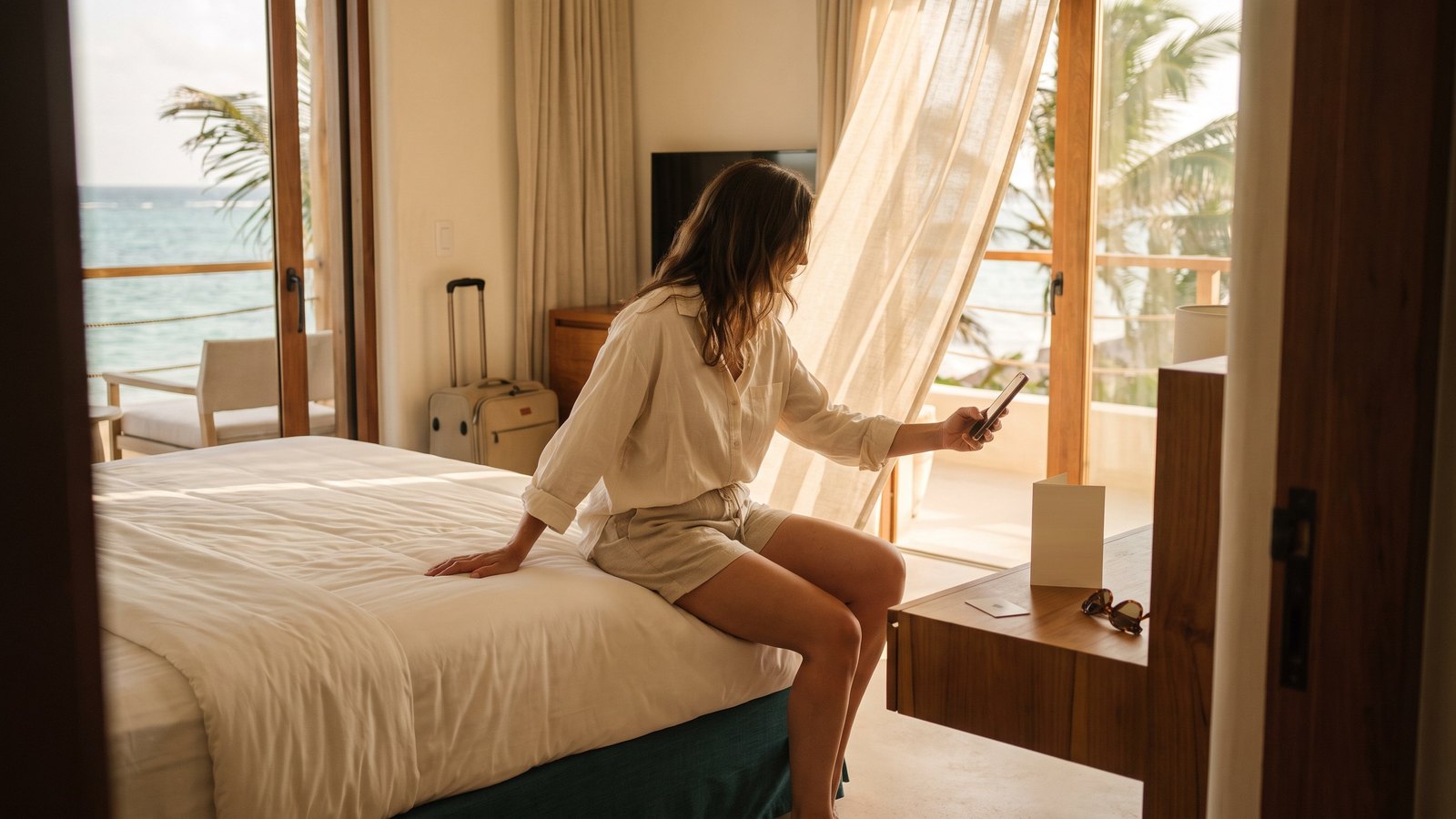
On this page
- 01Why do the big brands get value from apps when you might not?
- 02What do the data say guests prefer for communicating with a hotel?
- 03What do guests actually use a hotel app for?
- 04What is the alternative to a hotel app for an independent property?
- 05When does a hotel app actually make sense?
- 06How do you decide for your property in 30 days?
Most guests at an independent resort do not want to download your hotel app. In eviivo's 2025 survey of 430 travelers, 4% said they wanted a property's own app or a QR code to communicate with a hotel, against 58% who preferred SMS, WhatsApp or email links [2]. The satisfaction lift the big brands see from their apps comes from loyalty members who already had the app installed, which is a different population from a family on a one-time beach trip. So the answer to "should we build an app" is almost always "do the app's jobs without the download," and the vendor landscape for that is in our guide to the best hotel guest communication software.
I plan trips the way other people plan budgets, and I have never once downloaded an app for a three night stay. Not out of principle. I just needed to know where breakfast was, and the app store was between me and the answer.
Why do the big brands get value from apps when you might not?
Because their guests already have the app, and that changes everything about the numbers. In J.D. Power's 2025 North America Hotel Guest Satisfaction Index, drawn from 39,219 branded hotel guests, those who had downloaded the brand's app scored 699 on a 1,000 point scale, 68 points higher than non-users [1]. That is a real gap. It is also a gap between two groups who were different before anyone opened the app.
The guest who installs a Marriott or Hilton app is a loyalty member with points to watch, a room key in their pocket and a next stay to book. They were going to be more satisfied, more forgiving and more engaged whether or not the app existed, because they chose the brand on purpose and keep choosing it. The study does not report what share of guests used an app at all, and it does not claim the app caused the lift. The app development agency quoting you will skip that caveat. I would not.
An independent resort has none of the machinery that drives a download: no points, no portfolio, no mobile key fleet. What it has is guests who will visit once or twice, and the question for them is not "how do we get them to install something" but how to deliver the satisfaction without the install. Improving guest satisfaction without an app is a real option, and it starts with channels they already have.
What do the data say guests prefer for communicating with a hotel?
Messaging, by a wide margin, and the pattern is consistent across sources. eviivo's 2025 survey found 58% preferred SMS, WhatsApp or email links for quick exchanges, 25% preferred speaking to a person as long as follow-up was prompt, 13% preferred an OTA or major chain app, mainly for loyalty benefits, and 4% wanted a property app or QR code [2]. Note the 13%: the appetite for apps that exists attaches to OTAs and chains, where the guest has an account and a history, not to a single property. And be fair to the 4%: eviivo bundled QR codes with property apps in that answer, as a way to communicate. The case I make for QR codes below is narrower. The code is a door into the messaging channels the 58% already prefer, not a channel guests choose to talk on.
The appetite for self-service is real and separate from the appetite for an app. Oracle Hospitality and Skift's 2022 survey of 5,266 consumers found 73% were more likely to stay at a hotel offering self-service technology, 39% would order room service through a phone app or chatbot, and 38% wanted a fully self-service model with staff available on request [3]. That study is four years old and measured appetite for self-service in general, not for a property app in particular. Read it as "guests want to do things themselves," not "guests want your icon."
And they already message businesses constantly. Meta reported more than 600 million business-to-consumer conversations a day across its apps in 2023 [4]. The guest who texts a restaurant to change a reservation is not going to install software to ask a resort for towels.
What do guests actually use a hotel app for?
Six jobs, and most of them do not need an app. Ask a question. Make a request. See menus and hours. Book an activity or a spa slot. Receive messages about the stay. Check in and open the door. The table maps each job to the lightest container that handles it.
Guest jobs and the lightest container that does them
| Guest job | Native app | Mobile web via QR code or stay link | Messaging (SMS, WhatsApp, email) | Notes |
|---|---|---|---|---|
| Ask a question | Yes | Yes | Yes | Web chat or messaging answers from the knowledge base; nothing to install |
| Make a request | Yes | Yes | Yes | Becomes a task with an owner in any container |
| See menus and hours | Yes | Yes | Link | Mobile web renders menus; messaging sends a link |
| Book an activity or spa slot | Yes | Yes | By conversation | Mobile web is the natural fit |
| Receive stay messages | Push (needs permission) | Via link | Yes | Messaging reaches guests without a download |
| Check in and mobile key | Yes | Partial | No | Needs an app or a PMS program; not something a web concierge can do |
Operator mapping, 2026. "Yes" means the job is handled well in that container; mobile key is the only job that needs a native app.
Five of six jobs work in a mobile web page or a message, and the stay messages job is often better outside an app, because the pre-arrival message that answers day-one questions arrives on a channel the guest actually checks. What that sequence looks like is in a pre-arrival message sequence that cuts day-one questions. The sixth job, mobile key, is the honest exception, and it belongs to brands with a key program, not to a single property.
What is the alternative to a hotel app for an independent property?
A QR code and a stay link, pointing at a mobile web concierge, with messaging channels carrying the conversation. The guest scans the card on the nightstand or taps the link in their confirmation, a page opens in the browser, and they ask their question. No store, no account, no password reset on vacation.
This is how ResortConcierge AI works: a concierge guests open from a QR code with nothing to install runs in the phone browser, and from there they can ask questions, make requests and browse menus and activities. The same conversation can continue on SMS, WhatsApp or email, so a guest who would never install an app still gets the app jobs done in a channel they already use, and the property gets the same record either way.
The part operators actually wanted from an app was never the icon. It was knowing the guest: preferences, history, what was promised last time. ResortConcierge keeps that in guest profiles staff see across every channel, so the context travels with the conversation rather than with the download. If you want the wider picture of the category these pieces belong to, what guest communication software actually does lays it out.
One honest note: the platform does not issue mobile keys or run online check-in. Connectors to property management systems (PMS) are planned; today the alternative described here covers five of the six jobs, not all six.
When does a hotel app actually make sense?
Four cases, and I want to be fair to them, because apps work beautifully when the conditions are right. A loyalty program with a real repeat rate, where the guest has a reason to keep the app between stays. A multi-property footprint, where one install serves a dozen hotels. A mobile key program at scale, where the app replaces the plastic card across the portfolio. And in-room controls, where lights, climate and the TV need a native container to talk to.
If two or more of those describe you, build the app, and build the messaging alongside it, because the guest who did not install it still needs towels. If none describe you, the quote on your desk is for a tool most of your guests will never open.
The cost side I will leave as a question rather than a figure, because I do not have a sourced number for what a hotel app costs to build and maintain, and I would be suspicious of anyone who gives you one without seeing your requirements. What I can tell you is that "maintain" is the word to interrogate. Operating systems update, app store rules change, and someone has to answer the one star review that says "the app crashed when I tried to order breakfast."
How do you decide for your property in 30 days?
Measure the jobs, then run the lightest test. Here is the decision checklist I would hand a GM.
- Week one: count. For seven days, tally every guest question, request and booking by channel: desk, phone, email, text, WhatsApp. This is your job list.
- Week two: sort. Mark each item with the lightest container that handles it from the table above. Count how many need a native app. (It will be mobile key, if anything.)
- Week three: pilot. Put a QR code card in 20 rooms and a stay link in the pre-arrival message. Point both at a mobile web concierge.
- Week four: read the numbers. Scan rate per occupied room, conversations started, questions answered without a person, requests created.
- Decide. If the QR pilot handled the job list and the only gap is mobile key, you have your answer, and the app budget becomes a messaging budget.
This is the kind of test a founding partner property runs in its first month, and it costs a stack of printed cards. Before you sign anything with an app agency, spend seven days finding out what your guests actually ask for. I suspect, like me, they mostly want to know where breakfast is, and they want to know it without visiting a store.
Frequently asked questions
Private founding offer
Five resorts. One founding rate.
We are opening the concierge to five founding resorts. You get a locked founding rate, a 90-day readout on guest requests and staff time, and you start without a card.
- Open to five resorts only
- Founding rate locked in
- 90-day readout
- No card to start
Sources and notes (4)
- 1.2025 North America Hotel Guest Satisfaction Index (NAGSI) Study (opens in a new tab) J.D. Power, via Business Wire, 2025
- 2.eviivo survey: guest communication preferences (opens in a new tab) eviivo, 2025
- 3.Oracle Research: 73% of Travelers More Likely to Choose Hotels Offering Self-Service Tech (opens in a new tab) Oracle Hospitality and Skift, via Hospitality Net, 2022
- 4.Meta says users and businesses have 600 million chats on its platforms every day (opens in a new tab) TechCrunch, 2023

Written by
Brittany RoachWriter, guest experience
Brittany Roach writes about guest experience from both sides of the front desk: a career spent helping people through complicated moments, and a lot of time as a traveler with a family in tow.
Keep reading
Related articles
Hotel Guest Communication Software, Explained for Operators
What hotel guest communication software is, the four parts that matter, how the pricing works, and which features a resort under 150 rooms can safely skip.
Pre-Arrival Communication for Hotels: Five Messages, Timed Right
Pre-arrival communication for hotels that cuts day-one questions: five messages timed to the booking window, the channel for each, and one offer, not five.
WhatsApp for Hotels: The Operator's Guide to Staying in Control
WhatsApp for hotels, done properly: the Business Platform versus the app, Meta's opt-in rule, approved templates, shared inbox handoffs and what it costs.