Operations And Requests · 10 min read
Guest Request Response Time: Targets Guests Notice, Teams Can Hit
Guest request response time has no reliable industry benchmark, so set your own: three clocks, targets by priority, a month of timestamps and five cheap levers.

On this page
- 01What do guests actually expect when they ask for something?
- 02Why is there no reliable industry benchmark for request response time?
- 03What are the three clocks, and which one do guests feel?
- 04Where do the minutes actually go?
- 05What targets should a resort set?
- 06How do you measure response time with what you have?
- 07How do you reduce response time without adding staff?
Key takeaways
- There is no current, reliable industry benchmark for guest request response time; the 12 minute figure everyone quotes is a 2016 vendor survey.
- Three clocks: acknowledge, resolve, verify. Guests feel the first most, and it is the cheapest to fix because it can be automatic.
- Most of the minutes go into relay, ownership and discovery, not the work itself; in an illustrative 40 minute towel request, the work was eight minutes.
- Measure three timestamps per request for a month and read the 90th percentile, not the average; that is the request that becomes a review.
An acceptable guest request response time is one the guest never has to think about: acknowledged within a couple of minutes on chat or text, resolved within the time you were told, and checked on afterward. That is the direct answer. The uncomfortable part is that no reliable, current industry benchmark exists to tell you whether your property meets it, so you are going to have to measure your own. This post is about how, and it sits inside our guide to hotel guest communication software because the measuring and the fixing both run through the channels guests use to ask.
The review that starts this conversation is always the same one. "Took 40 minutes to get towels." The GM reads it, knows the housekeeper was on that floor within 10 minutes of hearing about it, and cannot prove where the other 30 went. Nobody can, because nobody wrote down when the request arrived.
What do guests actually expect when they ask for something?
To be heard first, and served second. Guests judge speed almost entirely on the acknowledgment. A reply that says "got it, towels within 20 minutes" in the first minute buys the full 20. Silence for five minutes followed by towels in 15 feels slower, even though it was faster. That gap, between what happened and what the guest felt, is the cost of slow response times in miniature.
The data on what guests want bears this out from a few angles. In eviivo's 2025 survey of 430 travelers, 25% said they would choose to speak with a person "as long as any required follow-up is prompt" [1]: the human is welcome, the waiting is not. In Oracle Hospitality and Skift's 2022 survey of 5,266 consumers, 34% named staff shortages and slow service as their top reason not to rebook a hotel [2]. And in Zendesk's 2025 CX Trends research across roughly 5,100 consumers in 22 countries, 63% said they were willing to switch to a competitor after one bad experience [3]; that figure is cross-industry, not hotel-specific, but I have never met a traveler who holds hotels to a lower standard than their bank.
The guest who waits 40 minutes rarely complains at the desk. They go quiet, and the complaint shows up in the review. My counseling years were full of the same pattern: the people who had decided you could not help were the ones who stopped asking. Catching an unhappy guest before the review is its own discipline, and it starts with noticing who stopped texting.
Why is there no reliable industry benchmark for request response time?
Because the number everyone quotes is from a 2016 vendor survey, and nothing public has replaced it. You will see "guests expect a reply to a text within 12 minutes" in dozens of articles. It came from a single vendor survey a decade ago, before most guests had ever messaged a hotel. I am not going to rely on it and neither should you.
What recent public data exists measures something adjacent. Here is what each figure tells you and what it does not.
| Source and year | What it measures | Figure | What it does not tell you |
|---|---|---|---|
| Shiji Guest Experience Benchmark, Q3 2025 [4] | Hotel response time to online reviews | 3.0 days globally, down from 4.7 days in Q3 2023 | Anything about in-stay request speed |
| Revinate Hospitality Benchmark Report, 2025 [5] | Reply speed on Revinate's own messaging platform | Automated replies in 1.8 seconds; staff replies in about three minutes; automation handled 31% of messages | How long the towels took to arrive |
| Oracle Hospitality and Skift, 2022 [2] | Traveler attitudes toward self-service and automation | 77% interested in automated messaging for service requests | What guests consider "too slow" |
| eviivo, 2025 [1] | Guest channel preferences | 25% want a person if follow-up is prompt | What "prompt" means in minutes |
Recent public data touching hotel response times, with the limits of each. Compiled 2026 from the sources cited.
The Shiji figure is worth a second look: a 36% drop in review response time in two years says the industry can move a clock when it decides to measure it. The Revinate figures are one platform's data, not an industry benchmark, but they show the shape of the thing: the automated acknowledgment is instant, the human reply takes minutes, and the physical fulfillment is not measured at all. Which is why you have to measure it yourself.
What are the three clocks, and which one do guests feel?
Time to acknowledge is the interval between a guest sending a request and knowing it was heard. Time to resolve is the interval between the request and the thing actually happening. Time to verify is the interval between done and someone asking whether it is right.
Guests feel the first clock most and judge you on the second. The first is also the cheapest to fix, because it can be automatic on any written channel: the request lands, the guest gets "received, about 20 minutes" before a human has read it. The second depends on staffing, distance and whether anyone knows who owns the request. The third is the one almost nobody runs, and it is the one that separates "the towels came" from "they cared whether the towels came."
A property with a problem usually has a fine second clock and a terrible first one. The housekeeper was fast. The guest just did not know anyone was coming.
Where do the minutes actually go?
Not into the work. Into the hand-offs around the work. Take the 40 minute towel request apart and the housekeeping part is the shortest segment.
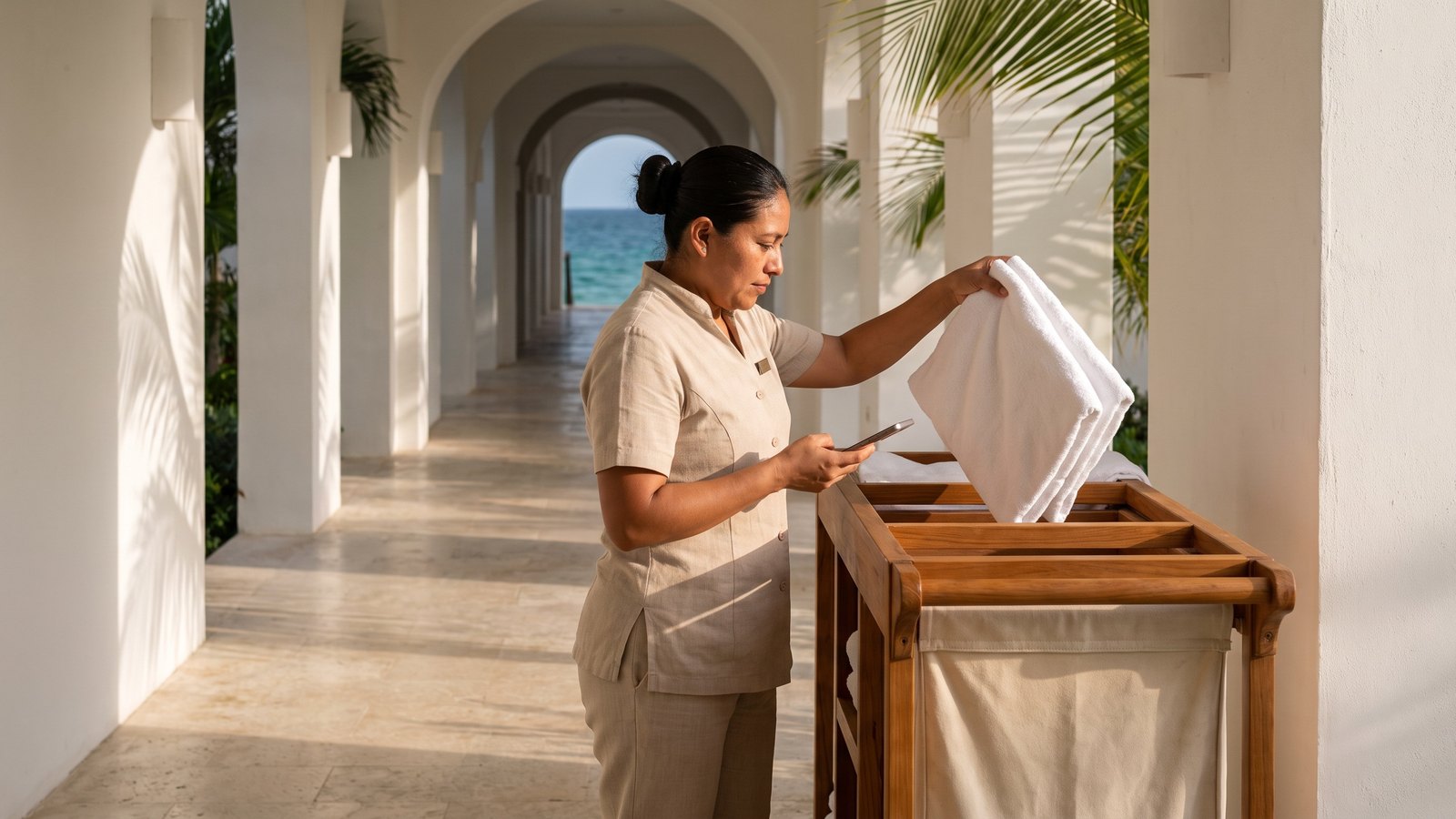
Illustrative: a 140 room resort, 4:30pm, a guest texts the desk for extra towels.
- 4:30 to 4:38, discovery: the desk agent is checking in a family and sees the text eight minutes later.
- 4:38 to 4:47, relay: the agent radios housekeeping, gets no answer, radios again, reaches the supervisor, who says she will pass it on.
- 4:47 to 4:58, ownership: the supervisor finishes a room inspection and tells the floor attendant, who was two floors away.
- 4:58 to 5:06, the work: the attendant restocks the cart and walks the towels to the room.
- 5:10, the guest, who heard nothing for 40 minutes, has already drafted the review in their head.
Eight minutes of actual work. In J.D. Power's 2025 study of 39,219 guests, satisfaction fell 217 points on a 1,000 point scale when a stay had a problem [6], and a 40 minute wait for towels is a problem in the guest's memory, whatever the housekeeping log says.
Thirty-two minutes of the request looking for an owner. This is the pattern at almost every property that routes requests through the desk, and staffing makes it worse: in the AHLA and Hireology 2025 survey of 282 hoteliers, housekeeping was the most critical opening at 38% of hotels and front desk at 26% [7]. The relay runs between the two most short-staffed departments in the building. Routing requests straight to the doing team removes the relay segment entirely, and that is where the minutes were.
What targets should a resort set?
By priority and by clock, published to the team, not to guests. Guests get a time per request ("about 20 minutes"), not a policy. The team gets the policy.
| Priority | Examples | Acknowledge | Resolve | Verify |
|---|---|---|---|---|
| Safety | Leak, lockout, medical word, security concern | At once, phone rings | Immediate action, status within 15 minutes | Same hour |
| Comfort | No AC, no hot water, room not cleaned, noise | Under 2 minutes | 30 to 60 minutes | Within 2 hours |
| Convenience | Towels, pillows, amenities, directions, bookings | Under 2 minutes | 20 to 30 minutes | Next morning message |
Illustrative targets for a mid-size resort, 2026. Set your own from your measured data; these are a starting shape, not a standard.
Two notes. Stricter targets at night only where staffing allows; a one-person overnight shift cannot hit a 20 minute towel target while running the audit, and pretending otherwise just produces misses. And acknowledgment targets can be the same at 3am as at 3pm, because acknowledgment should not depend on a human being free.
How do you measure response time with what you have?
Three timestamps per request, one month, one spreadsheet. You do not need software to start, though software makes it stop being a chore.
Measurement checklist:
- For every request, record: time received, channel, type, priority, time acknowledged, who acknowledged, time done, who did it, and whether anyone checked back.
- Run it for 30 days. Ask the desk to log phone requests too, or the sample is only the guests who text.
- For each clock and each type, compute the median and the 90th percentile. Not the average.
- Look at the 90th percentile first. That is the request that becomes a review.
- Pull the 10 slowest and read them. Where did the minutes go: discovery, relay, ownership or work?
Averages lie here. A property with a 14 minute average resolve time and a 90th percentile of 55 minutes has a towel problem one request in 10, and that one request writes the review. If you already run requests through a messaging platform, the timestamps exist; ResortConcierge AI records created, acknowledged, in progress and done on every service request, so response time by team as a report is a view you open, not a spreadsheet you build.
How do you reduce response time without adding staff?
Five levers, in cost order, and the first two are nearly free. I would do them in sequence and measure after each.
First, acknowledge automatically. Every written request gets an immediate "received, about [time]" from the system, so the first clock drops to seconds on every channel at every hour. Guests are fine with this: in the Oracle and Skift 2022 research, 77% were interested in automated messaging or chatbots for service requests [2]. This is the lever that moves the clock guests feel most, and it is where reducing hotel response times starts on ResortConcierge, because the AI answers or confirms receipt from the knowledge base and the desk never touches the first clock at all.
Second, route directly. Housekeeping requests go to housekeeping, maintenance to maintenance, with the desk informed rather than relaying. This deletes the segment where most of the 40 minutes lived.
Third, make the queue visible. A screen in the housekeeping office showing open requests by age does more than a radio ever did, because nobody has to remember.
Fourth, name an owner with a target. Every request has a role responsible for it and a time it should be done by. ResortConcierge uses smart escalation to move anything unanswered or negative to a person with its age showing, which is where the long tail of slow responses lives, and how an escalation queue keeps the long tail visible covers the mechanics.
Fifth, review misses weekly. Ten minutes, the 90th percentile, the five slowest requests, and one change. If you want to put a number on the hours the relay step consumes, estimate the hours involved before and after and show the owner the difference.
Start with the spreadsheet, tonight, with three columns. In 30 days you will have the only response time benchmark that matters, which is your own, and you will know exactly which segment to fix first.
Frequently asked questions
Private founding offer
Five resorts. One founding rate.
We are opening the concierge to five founding resorts. You get a locked founding rate, a 90-day readout on guest requests and staff time, and you start without a card.
- Open to five resorts only
- Founding rate locked in
- 90-day readout
- No card to start
Sources and notes (7)
- 1.eviivo survey: guest communication preferences (opens in a new tab) eviivo, 2025
- 2.Oracle Research: 73% of Travelers More Likely to Choose Hotels Offering Self-Service Tech (opens in a new tab) Oracle Hospitality and Skift, 2022
- 3.Zendesk 2025 CX Trends Report (opens in a new tab) Zendesk, 2024
- 4.Shiji releases Q3 2025 Guest Experience Benchmark (opens in a new tab) Hospitality Net, 2025
- 5.Hospitality Benchmark Report: Messaging Channel, North America (opens in a new tab) Revinate, 2025
- 6.2025 North America Hotel Guest Satisfaction Index Study (opens in a new tab) J.D. Power, via Hospitality Net, 2025
- 7.AHLA: 65% of surveyed hotels report staffing shortages (opens in a new tab) Hotel Management (AHLA and Hireology survey), 2025

Written by
Brittany RoachWriter, guest experience
Brittany Roach writes about guest experience from both sides of the front desk: a career spent helping people through complicated moments, and a lot of time as a traveler with a family in tow.
Keep reading
Related articles

The Hotel Escalation Queue: How AI Hands Guests to People
An escalation queue hotel teams can trust: what triggers a handoff from AI to a person, who owns the list, how fast to pick up, and what happens if nobody does.
How to Route Service Requests Through Chat to the Right Team
How to route service requests through chat: type each guest message, give it a priority and an owner, acknowledge the guest at once, and track it to done.
Service Recovery in Hospitality: Win the 48 Hour Window
Service recovery in hospitality is a timing problem. How to catch an unhappy guest before checkout, give each complaint an owner and a clock, and fix it fast.