Revenue · 9 min read
Late Checkout Upsell: Pricing, Timing and Housekeeping
A late checkout upsell works when it is priced by the hour, offered the evening before, capped by arrivals and housekeeping, and confirmed before the knock.
On this page
- 01Should hotels charge for late checkout?
- 02How much should a hotel charge for late checkout?
- 03When should a hotel offer late checkout?
- 04How many late checkouts can you sell today?
- 05How does the housekeeping handshake work?
- 06Late checkout or stay extension: which is the guest asking for?
- 07Where ResortConcierge helps
Key takeaways
- Late checkout is a capacity product with a daily inventory set by arrivals and housekeeping hours, not a favor the desk grants.
- Price it on a ladder by hour from your own ADR, offer it the evening before with a request cutoff, and write the free tiers into policy.
- The confirmed time must reach the housekeeping board and the attendant's sheet before the first knock, or the yes becomes a room not ready.
Late checkout is a capacity product: a few hours of a room that would otherwise sit empty between a departure and the next arrival. Sold well, it is priced by the hour, offered the evening before, capped by that day's arrivals and housekeeping hours, and confirmed to the room attendant before the first knock. Given away at the desk to whoever asks nicely, it is a housekeeping problem that housekeeping learns about at 11:15 from behind a door. The AI concierge platforms in our guide to the best hotel AI concierge platforms can send the offer and log the confirmation, but the product has to exist first, and that is a policy decision, not a software one.
I will admit a bias. With two kids, a 6pm flight and an 11am checkout, late checkout is not a perk. It is the difference between a good last day and five hours in a lobby with a suitcase and a child who needs a nap. I would pay for it every time, and I am not alone: in the Oracle Hospitality and Skift survey of 5,266 travelers in 2022, 37% said they would pay more for early check-in or late checkout [1].
Should hotels charge for late checkout?
Yes, as a default, with deliberate free tiers. The argument is not that generosity is wrong. It is that unpriced late checkout is unmanaged late checkout. Nobody counts it, nobody caps it, and the cost lands on the department with the least say in the decision.
The willingness to pay is there, and it is part of a wider pattern. In the same 2022 Oracle and Skift research, 54% of travelers said they would pay to choose their view, 37% for early check-in or late checkout, and 87% said they would be more likely to book a hotel that lets them pay only for the amenities they use [1]. That study is four years old now, so take it as directional rather than precise. The direction is clear enough: guests understand a la carte, and late checkout is the most natural a la carte item a hotel has.
Free tiers belong in the policy, written down. Loyalty members, guests recovering from a service problem, low-occupancy days when the rooms would sit empty anyway: all reasonable reasons to waive the fee. The point is that the waiver is a decision the property makes in advance, not a favor the desk agent grants under pressure.
How much should a hotel charge for late checkout?
There is no published fee benchmark I would put in front of an owner, so build a ladder from your own average daily rate (ADR). The logic: each additional hour costs housekeeping flexibility and the next guest certainty, so the price should climb with the hour, and the top rung should sit near a half-day rate because at 4pm you have effectively sold half a room night.
| Checkout time | Share of ADR (illustrative) | Price at a hypothetical USD 250 ADR | Who can approve |
|---|---|---|---|
| 11am (standard) | 0% | USD 0 | Automatic |
| 1pm | 10% | USD 25 | Front desk, within the daily cap |
| 2pm | 20% | USD 50 | Front desk, within the daily cap |
| 4pm | 40% to 50% | USD 100 to 125 | Manager, or automatic on low-occupancy days |
| After 4pm | Stay extension, not late checkout | Room night rate | Reservations |
Illustrative pricing ladder. The shares and the USD 250 ADR are invented for the example, 2026. Set yours from your own rate and arrival pattern.
Two notes on the ladder. First, the 1pm rung is as much a conversation starter as a revenue line: a small, clearly priced option makes the larger ones feel reasonable. Second, the price should be the same whether the guest asks in chat, by phone or at the desk, because inconsistent fees are how guests learn to negotiate.
If you want to see what a modest daily count does over a year at your rate, the ROI calculator will take your numbers. The arithmetic is not complicated. The discipline is.
When should a hotel offer late checkout?
The evening before departure, after tomorrow's arrivals are known, and never as a surprise at the desk. By the evening, the property knows how many rooms it needs back early and how many attendants are on shift. The guest knows whether tomorrow is a 6am taxi or a 6pm flight. Both sides have the information they need to say yes.
Here is a timing that holds up.
- Day before, 6pm: tomorrow's arrival list is final enough to count rooms needed before 3pm.
- 7pm: the offer goes to departing guests only, with the day's prices and a plain line about the cutoff.
- 9pm: request cutoff. Requests after this go to the front desk, case by case.
- 9:30pm: housekeeping builds tomorrow's board with the confirmed late rooms marked and their new vacate times.
- Departure day, 8am: each attendant sees the late rooms on their sheet before the first knock.
- Paid window ends: the room is released, and if the guest overstays, the desk follows the policy written on the confirmation.
The reason the evening works is the same reason behind the upsell moments guests say yes to: the offer lands when the guest is already thinking about the decision. At 7pm the night before, a family is talking about tomorrow. At 10:50am with bags packed, they are leaving, and a fee feels like a toll.
How many late checkouts can you sell today?
The sellable count is a daily number, not a policy. Rooms departing today, minus rooms needed for arrivals before your late hour, minus a buffer, checked against the attendants on shift. Some days that is twenty. Some days it is zero, and saying zero is better than a room not ready at 3pm.
| Line | Illustrative value |
|---|---|
| Rooms | 150 |
| Departures today | 60 |
| Arrivals needing a room before 3pm | 35 |
| Buffer for early arrivals and surprises | 10 |
| Rooms that can go late on arrivals alone | 15 |
| Attendants on afternoon shift, rooms each in the 1pm to 4pm window | 4 attendants, 3 rooms each = 12 |
| Sellable late checkouts today | 12 (the lower of the two constraints) |
Illustrative daily inventory for a hypothetical 150 room resort. Every value is invented for the example, 2026.
The housekeeping constraint is usually the binding one, and the labor data explains why. In the AHLA and Hireology survey of 282 US hoteliers fielded over December 2024 and January 2025, 65% reported staffing shortages, and housekeeping was the most critical need at 38%, ahead of front desk at 26% [3]. STR's 2024 P&L sample put labor cost per available room at USD 72.44, up 11% in a year [2]. An unplanned late checkout that forces an attendant into overtime, or a rush clean before a 3pm arrival, is not free just because the fee was waived. That is the operational face of the hotel staffing shortage: the department with the fewest spare hours absorbs the decisions made elsewhere.
How does the housekeeping handshake work?
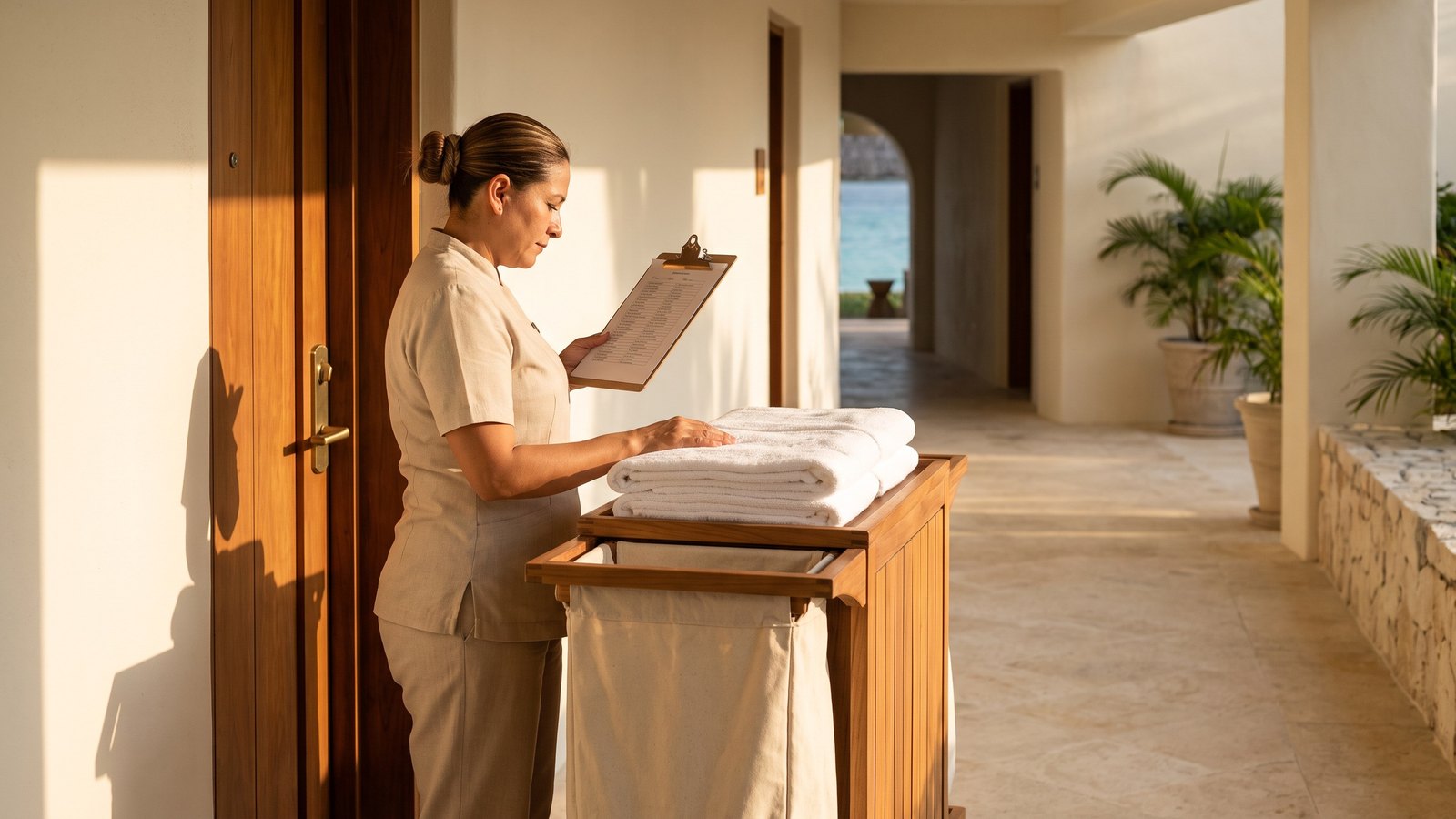
The confirmed time has to reach two places: the board the executive housekeeper plans from, and the sheet the attendant carries. If it reaches only one, the knock still happens.
| Step | Owner | System of record |
|---|---|---|
| Guest confirms late checkout in chat or at the desk | Front desk | The request, with the time and the price |
| Room marked with the new vacate time | Front desk | The housekeeping board (and the PMS, as a staff step) |
| Attendant sheets printed or updated with late rooms flagged | Executive housekeeper | The board |
| Attendant checks the flag before the first knock | Room attendant | The sheet |
| Guest overstays the paid window | Front desk | The policy on the confirmation |
| Room released and cleaned | Housekeeping | The board |
Late checkout handshake. Practice checklist, 2026, not a standard.
The stakes on the other side of the handshake are the arriving guest. In J.D. Power's 2025 North America study of 39,219 hotel guests, 12% experienced a problem during their stay, and when a problem occurred, satisfaction fell 217 points on a 1,000 point scale [4]. A room not ready at 3pm because a late checkout collided with an arrival is one of the most avoidable problems on that list. The pattern for not losing the handoff is the same one that works for a handoff system for housekeeping and maintenance requests: the information lives on the screen, not in someone's memory.
Late checkout or stay extension: which is the guest asking for?
"Can we stay a bit longer?" is two different products wearing the same sentence. Late checkout is hours, same day, a fee, approved by the desk within the daily cap. A stay extension is another night, a room rate, approved by reservations against availability. The first question for anyone who hears the request, human or AI, is which one the guest means.
The routing matters because the approvals differ. A late checkout to 2pm on a day with inventory should be an instant yes at the ladder price. An extra night on a sold-out Saturday is a conversation about availability and rate that the desk should not improvise. The concierge's job is to recognize the fork and send each path to the right owner, the way room service orders move from chat to the kitchen without the front desk retyping them.
Where ResortConcierge helps
The general practice is an offer at the right hour, a confirmation the whole team can see, and a board that changes before the knock. ResortConcierge AI sends the late checkout offer through notifications with audience targeting, which is how the platform handles the late checkout and upsell path: departing guests only, the evening before, at the price the property sets for that day.
A confirmed late checkout becomes a request with status and an owner, visible to housekeeping with a status and an owner so the executive housekeeper sees it when building the board rather than hearing about it from an attendant at 11:15.
The confirmed time is also recorded on the guest profile, so any team member who answers that guest sees it. Two honest limits: updating room status in the property management system (PMS) and posting the fee to the folio are staff steps today, because PMS connectors are planned, not shipped.
Start with the ladder and the cutoff. Write both down, show them to housekeeping before you show them to guests, and send the first offers on a light arrival day. The handshake will tell you within a week whether the board is changing before the knock, and that, not the fee, is the thing to get right first.
Frequently asked questions
Private founding offer
Five resorts. One founding rate.
We are opening the concierge to five founding resorts. You get a locked founding rate, a 90-day readout on guest requests and staff time, and you start without a card.
- Open to five resorts only
- Founding rate locked in
- 90-day readout
- No card to start
Sources and notes (4)
- 1.Hospitality in 2025: Automated, Intelligent... and More Personal (opens in a new tab) Oracle Hospitality and Skift, 2022
- 2.U.S. hotel profits grew in 2024 but were limited by inflation and labor costs (opens in a new tab) STR (CoStar), via Hotel Online, 2025
- 3.65% of surveyed U.S. hotels report staffing shortages (opens in a new tab) AHLA and Hireology, via Hospitality Net, 2025
- 4.J.D. Power 2025 North America Hotel Guest Satisfaction Index Study (opens in a new tab) J.D. Power, via Business Wire, 2025

Written by
Brittany RoachWriter, guest experience
Brittany Roach writes about guest experience from both sides of the front desk: a career spent helping people through complicated moments, and a lot of time as a traveler with a family in tow.
Keep reading
Related articles

Hotel Upselling Strategies: The Moments Guests Say Yes To
Hotel upselling strategies built on timing, not scripts. Which offers guests actually buy, when they say yes, and the moments that make them resent the pitch.

Hotel Shift Handover: Stop Losing Guest Requests at 3pm and 11pm
A hotel shift handover system that keeps guest requests alive: one owner at every minute, explicit transfer, a shared open requests list and a short stand-up.
Reduce OTA Dependency: The In-Stay Levers Most Resorts Ignore
To reduce OTA dependency, treat the stay as the acquisition channel for the next booking: a direct channel on day one, consent, a rebook offer before checkout.