Staffing And Labor · 11 min read
Hotel Staffing Shortage Solutions: A Realistic Plan for 2027
Hotel staffing shortage solutions start with the people you can actually hire. Build the 2027 plan from tasks, automate routine questions, hire for judgment.

On this page
- 01What does the hotel labor outlook actually look like?
- 02How many hotels are short, and where?
- 03Why does hiring harder not fix it?
- 04How do you build the plan from tasks instead of titles?
- 05What can a hotel automate without losing the personal touch?
- 06What should a hotel hire for in 2027?
- 07How do hotel staffing shortage solutions fit in the budget?
- 08Where ResortConcierge helps
Key takeaways
- U.S. hotel employment was projected at 2.17 million for 2025, about 200,000 below 2019, while compensation hit a record (AHLA 2025); the people are not coming back on the 2019 org chart.
- Quits in accommodation and food services ran 4.2% against 2.0% for all industries in 2025 (BLS), so hired-in headcount leaks.
- Build the plan from a one-week task inventory: automate routine information and request intake, redesign transactions, hire for judgment and recovery.
- Budget hours by task group, not FTEs by title, and measure interruptions per shift rather than efficiency.
- Automation shifts work; it does not delete a headcount line in year one, and the plan should say so.
The honest 2027 staffing plan starts from the people you can actually hire, not the org chart you had in 2019. The industry employs about 200,000 fewer people than it did then, nearly two thirds of hotels report shortages, and desk clerk jobs are projected to grow about 2% over the next decade. So the hotel staffing shortage solutions that work are not "hire harder." They are: automate the routine questions and request intake, redesign the transactions, and hire fewer, better paid people for judgment, recovery and presence. The AI side of that is covered in our guide to hotel AI concierge platforms; this post is about the plan.
The budget template is lying to you, politely. It has eight front desk lines because it had eight in 2019. You have five. The three empty rows are not a hiring problem waiting to be solved. They are a design problem waiting to be noticed.
What does the hotel labor outlook actually look like?
Put the numbers in one place, with years, so the owner meeting is about the plan and not about whether the problem is real.
| Measure | Figure | Year | Source |
|---|---|---|---|
| U.S. hotel employment, 2019 | 2.37 million | 2019 | AHLA 2025 |
| U.S. hotel employment, projected | 2.17 million | 2025 | AHLA 2025 |
| Jobs lost to the pandemic, then added back | 680,000 lost; 467,000 added back over four years | 2020 to 2024 | AHLA via Hotel Dive 2025 |
| Wages, salaries and compensation, projected | USD 128.47 billion (record) | 2025 | AHLA 2025 |
| Compensation vs 2019 | 25.6% higher | 2025 | AHLA via Hotel Dive 2025 |
| Desk clerk employment, projected | 264,600 to 269,500, about 2% growth | 2025 to 2035 | BLS via O*NET |
| Projected annual desk clerk openings | 35,500 | 2025 to 2035 | BLS via O*NET |
Labor outlook figures with their years and sources. U.S. national data; resort markets vary, and seasonal markets vary more.
AHLA's 2025 State of the Industry report projected hotel employment at more than 2.17 million, roughly 200,000 below the 2.37 million of 2019, while compensation reached a record USD 128.47 billion [1]. Hotel Dive's reporting on the same AHLA data put the gap in motion: more than 680,000 jobs lost, more than 467,000 added back in four years, compensation 25.6% above 2019, and only Montana and Washington, D.C. expected to exceed pre-pandemic staffing [2]. The Bureau of Labor Statistics projects desk clerk employment growing about 2% between 2025 and 2035, slower than average, with 35,500 openings a year against a base of 264,600 [4]. Read that last pair twice: the role refills a large share of itself every year.
You are paying more for fewer people, and the pipeline is not widening. That is the hotel staffing shortage in three clauses, and no amount of recruiting creativity changes the first two.
How many hotels are short, and where?
Most of them, and in the roles most exposed to routine work. The AHLA and Hireology Front Desk Feedback survey of 282 hoteliers, fielded December 2024 to January 2025, found 65% reporting staffing shortages, down from 76% in May 2024 but still two in three, with 9% severely understaffed and 71% holding openings they could not fill, six to seven per property on average [3].
The most critical openings were housekeeping at 38% and front desk at 26%, then culinary at 14% and maintenance at 13% [3]. Notice what the top two have in common. Both are roles where a large share of the day is routine: the same questions, the same requests, the same intake. That is not a coincidence, and it is the opening the plan walks through. The roles you cannot fill are the roles whose routine load you can most easily move.
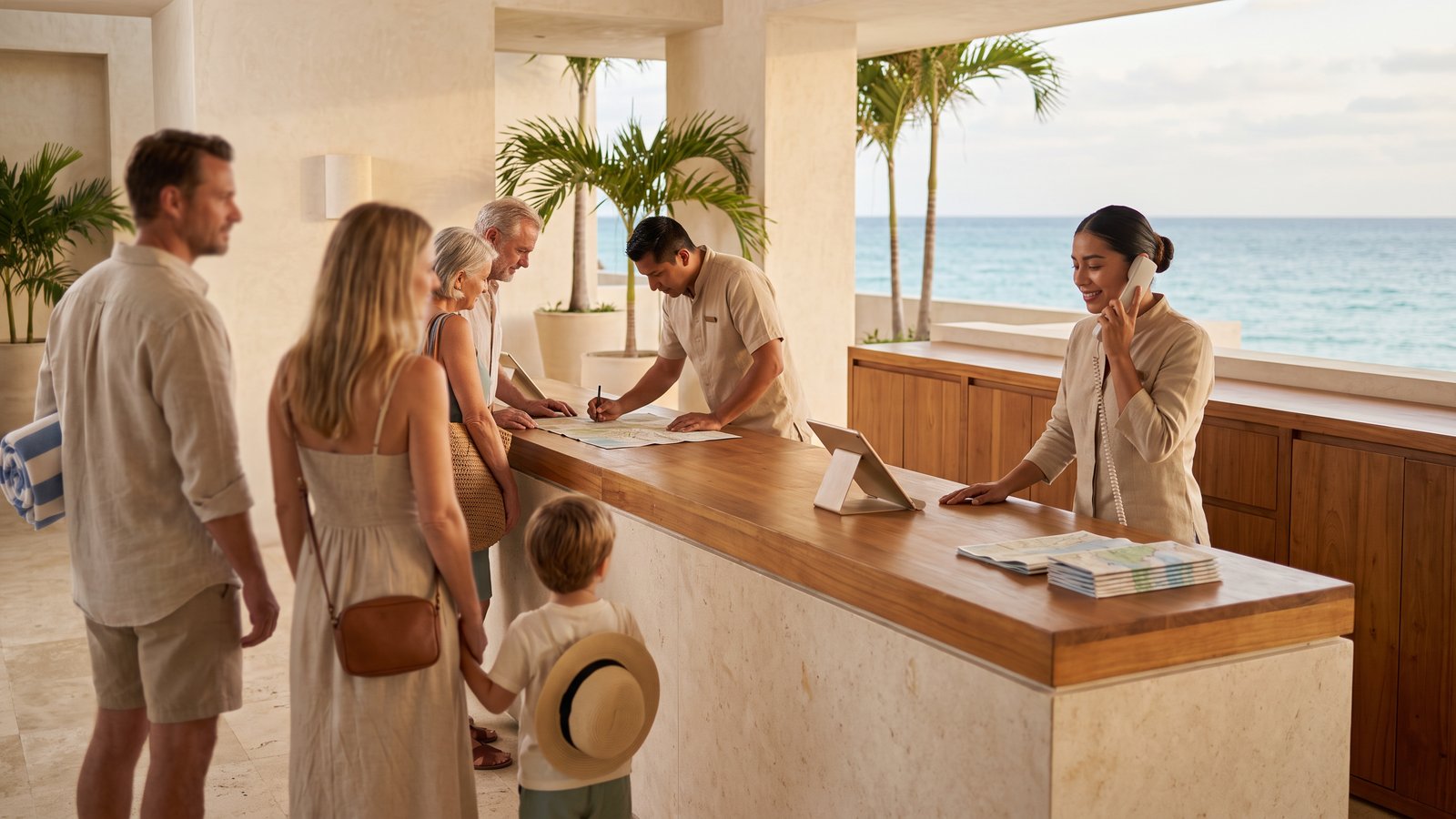
I think about the agent in the hero photo, alone at a desk built for three. She is not short on skill. She is short on hours, and most of the hours she does have are being spent telling people where the pool is.
Why does hiring harder not fix it?
Because the headcount leaks. The Bureau of Labor Statistics put the 2025 annual quits rate for accommodation and food services at 4.2%, against 2.0% for all nonfarm industries, and total separations at 5.5% against 3.3% [5]. Roughly double, on both measures. A property that hires three people into that leak is back to recruiting before the third one has learned the Wi-Fi password.
Wages are already the lever most hotels have pulled. In the AHLA and Hireology survey, 47% were raising wages and 20% offering flexible hours [3], and compensation sits at a record [1]. Paying more is right, and it is also not sufficient, because the problem is not only pay. It is a job where a thoughtful person spends half a shift answering the same twenty questions and goes home feeling like a kiosk.
Years of counseling taught me to read turnover as a symptom of mismatch. People leave jobs that use the wrong part of them. If you hire for warmth and judgment and then spend those people on directions to the parking lot, they leave, and the exit interview says "pay," because that is the polite thing to say. One line for the HR file: role changes and scheduling touch employment law, so this is general information and your own counsel should look at any restructuring.
How do you build the plan from tasks instead of titles?
Log one week. Every front desk and guest service interaction, in four groups: routine information, transactions, request intake, and judgment and recovery. Minutes per occurrence, occurrences per week, hours per group. Do it with the team on shift, on paper if that is what gets done, and resist cleaning it up.
Illustrative: a hypothetical 150 room resort, one representative week.
| Task group | Examples | Minutes each | Times per week | Hours per week | Decision |
|---|---|---|---|---|---|
| Routine information | Hours, directions, Wi-Fi, policies, menus | 2 | 1,800 | 60 | Automate |
| Transactions | Check-in, checkout, payment, folio questions | 6 | 900 | 90 | Redesign |
| Request intake | Towels, maintenance, late checkout, room service | 3 | 700 | 35 | Automate intake, people fulfill |
| Judgment and recovery | Complaints, exceptions, special situations, presence | 12 | 200 | 40 | Hire for this |
| Total | 225 |
Illustrative task inventory for a hypothetical 150 room resort, 2026. The counts are assumptions for the arithmetic, not measured data. Build yours from a real week.
In this model, 225 hours of weekly desk work is about five and a half full-time people, and 95 of those hours, routine information plus request intake, are the kind a knowledge base and chat can carry. That does not make 95 hours disappear. It moves them: from answering to fulfilling, from the phone to the lobby, from interruptions to the complaint that needs a human now. What 40 repetitive questions a day cost a 150 room resort runs the cost side of the same arithmetic.
The number that matters is not the total. It is the split, and the split is what the budget has never seen.
What can a hotel automate without losing the personal touch?
Routine information and request intake, and the test for each task is one question: would a guest rather wait for a person for this? For the pool hours at 6am, no. For "is the kids' club open on Sunday," no. For the first step of a towel request, no, as long as a person delivers the towels. For "our room smells like smoke and my daughter has asthma," absolutely yes, and the automation's only job is to get that message to a human in under a minute.
The guest data agrees with the split. In the 2025 Hotel Tech Report survey of 402 travelers, 70% said chatbots are helpful for simple tasks [6]. Simple tasks. Not complaints, not exceptions, not the moment a family arrives at 7pm with a sleeping child and a reservation that somehow has the wrong dates. I have been that family. The thing I wanted was a person who could decide, not a person who was busy explaining the breakfast hours to someone else.
So automate the question, not the person. A property knowledge base that answers the forty routine questions on web chat and text, and a request intake that creates a task with an owner, is the general practice. It does not replace the agent. It gives her back the hours, and those hours are what the next section spends.
What should a hotel hire for in 2027?
Judgment, recovery, presence and overnight accountability. Fewer roles, paid better, with the routine load removed so the job is the job you described in the posting.
Judgment is the person who can make the exception: move the room, comp the dinner, decide that this guest's complaint is the one that needs the GM. Recovery is the person who owns a flagged conversation until the guest says it is fixed. Presence is someone in the lobby at 7pm who can read a tired family before they reach the desk. Overnight accountability is the person who is awake and responsible after 10pm, and covering the desk after 10pm is its own planning problem.
Guests still want these people. In the 2025 Hotels.com survey of 450 hotels, 70% said guests still prefer human staff for check-in and support [7]. Read that beside the 70% who find chatbots fine for simple tasks [6] and the plan writes itself: humans for the human moments, software for the pool hours.
Add one more role the org chart never had: the knowledge owner. Someone whose job includes keeping the property's answers current, because every automated answer is only as good as the text behind it. At a seasonal property this role is also how onboarding seasonal front desk staff in a week becomes possible, since new hires learn from the same source guests do.
How do hotel staffing shortage solutions fit in the budget?
Hours by task group, not FTEs by title. The 2027 budget line reads "front desk and guest service: 225 hours per week, of which 95 automated intake and information, 130 staffed," and then the staffed hours are costed at the better wage the smaller team deserves. A redeployment line shows where the freed hours go: lobby presence, recovery, the knowledge owner.
Then a measurable target, and not "efficiency." Interruptions per shift, counted. Requests lost between shifts, counted. Time to first reply on a flagged conversation. Pick one, baseline it in the inventory week, and review it quarterly. An owner will fund a plan with a number they can check in March. The ROI calculator will give you a starting frame for the labor math, with your own inputs.
Two honesty notes for the owner meeting. Automation shifts work; it does not remove a headcount line in year one, and the plan should say so rather than promise it. And phone volume stays with people for now: voice AI is planned on the ResortConcierge AI side, not shipped, so the plan should not assume the phone rings less in 2027.
Where ResortConcierge helps
The practice is a task inventory, automated routine information and intake, and people for judgment. ResortConcierge answers the routine information questions, hours, directions, Wi-Fi, policies, from the property knowledge base through web chat with QR or stay link entry, which is the task group the inventory usually shows as the largest.
Request intake comes off the phone through service requests with status and an owner, so housekeeping and maintenance work from a queue instead of a radio.
The judgment work lands in the escalation queue, which gives the "hire for judgment" roles a defined inbox rather than a hope that the right message reaches the right person. Voice is planned; PMS connectors are planned; the platform runs standalone today.
Start the inventory week on Monday. Give the team a tally sheet, four columns, no judgment about what goes where yet. By Friday you will have a split instead of a headcount, and the 2027 budget will finally be describing a desk that exists.
Frequently asked questions
Private founding offer
Five resorts. One founding rate.
We are opening the concierge to five founding resorts. You get a locked founding rate, a 90-day readout on guest requests and staff time, and you start without a card.
- Open to five resorts only
- Founding rate locked in
- 90-day readout
- No card to start
Sources and notes (7)
- 1.State of the Industry: Hotels Face Rising Costs and Flattening Growth (opens in a new tab) American Hotel and Lodging Association (AHLA), 2025
- 2.Hotel staffing to remain 'well below' pre-pandemic levels (opens in a new tab) Hotel Dive, reporting AHLA 2025 State of the Industry Partner Trends and Insights, 2025
- 3.AHLA: 65% of surveyed hotels report staffing shortages (opens in a new tab) Hotel Management, reporting AHLA and Hireology Front Desk Feedback survey, 2025
- 4.National Employment Trends: 43-4081.00 Hotel, Motel, and Resort Desk Clerks (opens in a new tab) O*NET OnLine, citing Bureau of Labor Statistics 2025 to 2035 projections, 2025
- 5.Table 22. Annual average quits rates by industry and region, not seasonally adjusted (and Table 20, total separations) (opens in a new tab) Bureau of Labor Statistics, Job Openings and Labor Turnover Survey, 2026
- 6.AI, Chatbots and Smart Checkouts: What Today's Luxury Travelers Really Want (opens in a new tab) Hospitality Net, citing Hotel Tech Report 2025 State of Hotel Guest Tech Report, 2025
- 7.Hotels.com Survey (opens in a new tab) Hotels.com, via Business Wire, 2025

Written by
Brittany RoachWriter, guest experience
Brittany Roach writes about guest experience from both sides of the front desk: a career spent helping people through complicated moments, and a lot of time as a traveler with a family in tow.
Keep reading
Related articles
Reduce Front Desk Calls: The Real Cost of Routine Questions
What routine guest questions cost a 150 room resort each month, and how to reduce front desk calls by moving that volume to channels guests already use.

Seasonal Hotel Staff Training: Onboard a Front Desk in a Week
Seasonal hotel staff training in five days: put the property's answers in one knowledge base, run read, systems, shadow, buddy, solo, and log what is missing.
After Hours Hotel Coverage Without a Night Auditor Doing Two Jobs
After hours hotel coverage in three streams: questions that need no person, requests that can wait until a stated time, and problems with a named on-call owner.